Keith Barton sent me a draft copy of what he has written about student’s understanding of the Treaty of Waitangi and it brought up a couple of key things. I had asked students what they thought New Zealand was like in the 1830s and we did an activity to deal with the misconceptions, but I didn’t ask them why they thought the Treaty of Waitangi was signed. Barton has found that when asked cold New Zealand students say it was because Maori wanted peace between the races and the Europeans wanted to rip Maori off. Both positions are overly simplistic and, according to Barton, make learning about the Treaty an unpleasant experience for all. Maori students come out thinking that their ancestors were powerless with no agency (of course there is no recognition that not all Maori did in fact sign the Treaty with this interpretation) and European students are made to feel guilty. All other students didn’t have ancestors there so it really is an irrelevant topic for them.
My students have been making posters on the Treaty of Waitangi and the key differences between translations and Maori and European reasons for signing it. Although we had done a class role-play which highlighted a more complex understanding of the event than the two commonly held assumptions, some of the imagery and that they are producing in their posters would suggest that this was a crucial step requiring some carefully chosen sources and activities. For example, one group’s poster had a Maori and Pakeha hand clasped together; a nice idea by two very able students – but missing the true nature of the event.
There are two ways to get around this. First, talking openly about the fact that we are learning about something controversial which we all recognise is often taught badly has proven quite successful so far. So, I have turned Barton’s short draft article critiquing the way the Treaty is taught into a resource which we will read together with lots of rhetorical questions for us to discuss. Secondly, we have touched on enough sources to expose some of the complexity surrounding this event that when we come to evaluate the posters together with my historical thinking rubric, we will be able to undo some of the damage my lack of knowledge has created. It would have been great to have had the historical thinking discussion before we made the posters – the exercise would have been much more of a learning experience.

Showing posts with label History Education. Show all posts
Showing posts with label History Education. Show all posts
Sunday, August 8, 2010

Tuesday, August 3, 2010
Does historical knowledge about the Treaty of Waitangi influence students’ beliefs about its role today?
In response to some interesting (and I think valid) criticism in the media from Peter Adds and Richard Manning regarding the lack of New Zealand race relations history taught in New Zealand schools, and the equally valid accusation that history teachers “avoid” it because it is controversial, I decided to flag the Israel/Palestine topic for term three and look at how land is contested in New Zealand. Having never properly taught the Treaty of Waitangi before, I decided I needed a decent research question to make it more interesting.
This topic also comes at a time when some of the Wellington History teachers are organising the NZHTA conference, and for the first time, as far as I know, actually going to meet Te Ati Awa. Short of Manning’s suggestions that an official relationship and memorandum of understanding be established between Te Ati Awa and Port Nicholson Block schools, I am launching ahead, although not in the kind of place-based manner that this kind of topic actually deserves. The historical GIS maps put together by Te Ati Awa look amazing – such a geographical approach towards the past is surely the way of the future if we are to start engaging students, especially Maori ones. I have no more history internal assessments left thanks to our addiction to the “rigour” of external assessment and am using an internal, Level One social studies assessment on values exploration and have called this unit of learning “The Legacy of Waitangi”.
Naturally students were not jumping out of their seats to be doing this topic so we started with a method I have Andrea Milligan from Victoria University of Wellington to thank for. Called a “Collective Biography” it was a great way to acknowledge that student’s prior experiences of learning this stuff has been quite negative as well as the fact that students’ own cross-cultural experiences tend towards the negative too.
Asked to describe a story in their life about a personal memory or experience with the Treaty of Waitangi or Maori and Pakeha relations, we shared this while sitting in a circle. I started with a few examples, and we went around a few times so those who passed at first could get ideas or have a memory triggered from someone else’s story. It is really interesting what you find out about your students doing this.
99% of students came up with something and we wrote them up and put them on the wall as in the picture. Following this, students responded to the prompts in a free writing exercise and came up with some varied responses. It was a good way to break the ice and it definitely wasn’t “boring”. There was a bit of discussion and disagreement and lots of acknowledgment that this topic is generally taught very badly. Which is a little scary – if I don’t deliver I will be another example of how education can screw up student’s appreciation of an important issue. The generally negative experiences from the collective biography expressed in an undeniable way that New Zealand has a problem. So my next question was “can history help?” which is a pretty fascinating question. There was some difference of opinion about this, (students claiming that if we don’t know anything about it that will mean we don’t have anything to disagree with) but by and large they agreed that some historical knowledge would at least help them to participate in a conversation about the role of the Treaty of Waitangi in the 21st Century. Incidentally, this is the final assessment task too. They need to:
Explain, in depth, why people hold differing values positions on the role of the Treaty of Waitangi today.
Describe, in depth, consequences for society of people holding differing values positions on the role of the Treaty of Waitangi today.
The next task worked well; a pretty basic diagnostic assessment task but one that generated information that I am actually using. Students filled in “The Treaty of Waitangi pre-assessment chart” and we stuck them all on the wall, half of which are evident in the photograph. For students who have ‘done the Treaty’ and ‘hundreds of times’, there was a whole lot of critical stuff that they didn’t know and which they thought they needed to know in order to “have an intelligent conversation about the role of the Treaty today”, which was great, because that assessment wall is serving as my unit plan.

A lot of students wanted to know a bunch of factual stuff as well as why it was signed so the first lessons have been a fly through the 1830s. We brainstormed what they thought the 1830s might be like and then read a text and watched a state service commission CD rom . From this we got a whole lots of key concepts and I listed artefacts that could potentially relate to those concepts. For example, the 1830s were a time of European lawlessness and an associated artefact could be a broken piece of glass. Students had to choose an artefact, make or find it, and write a 60 word summary linking the artefact to the big idea. We then put them all on the table as an exhibition and using the historical thinking rubric of evidence, agency and perspective, critiqued what this exhibit on the 1830s told us about New Zealand in this time and what it didn’t tell us. My knowledge of this era is woeful but know I want to learn everything I can about this decade. There is heaps of really critical important information about why the Treaty was signed that they aren’t going to get from me this year, for example we should look at the 1831 Chief’s petitions, the relationship between the 1835 Declaration of Independence and the Treaty and Normanby’s letter to Busby. They have the basics though about life in the 1830s and why the Treaty was signed. It goes to show how important teacher’s knowledge is though for it to be done really well. After that we will look at what was actually in the treaty and then they are doing a mini inquiry in the library where they need to report on an event between 1840 and 2010 where the Treaty of Waitangi was either honoured or breached.
And then it is into the present day stuff and my research question starts to come into play. I have online discussion forums, anecdotal comments, their history journals and their assessments which I can use for evidence. I have also developed a series of perspective cards on the treaty with their key assumptions. For example:
Biculturalism
–The Treaty is New Zealand’s founding document.
–The Treaty symbolizes a unique relationship between Maori and the Crown (the Government) and is what gives Pakeha the historical right to be on this land.
–The Treaty should serve as the basis of an ongoing partnership with rights and responsibilities for both parties.
Social Justice perspectives
–Educational, health, employment and crime statistics show that Maori are more vulnerable than Pakeha, a clear breach of the Treaty of Waitangi, especially article three.
–New Zealand society today is inherently unequal between Maori and Pakeha due to the massive confiscation and alienation of Maori from their land.
–Historical understanding of New Zealand’s colonial history is absolutely critical to solving today’s problems.
Treaty as contract
–Maori ceded their sovereignty (political authority) with the signing of the Treaty.
–Injustices towards Maori have occurred in New Zealand and need to be researched and addressed through the Waitangi Tribunal as soon as possible.
–The Treaty should have no role as a “Partnership” between Maori and Pakeha.
Treaty as irrelevant
–What happened 170 years ago cannot possibly have any real bearing on the present.
–The treaty has no legal standing, it is a “legal nullity”.
–The “Treaty Industry” is bleeding the New Zealand economy and leading to separatism between the races.
– Just like William Hobson said “he iwi tahi tatou”, we are all one people and there should be one and the same system for all.
These are not perfect and I also want to look at the “Beyond Biculturalism” arguments and multiculturalism as a perspective on the role of the Treaty today. We will use this to discuss the views of people like Don Brash and the Orewa speech and responses to it, Robert Consadine’s 2006 Waitangi Day speech and Te Ati Awa beliefs about the role of the Treaty. Long term it would be great to have a “perspectives card” that was developed with Te Ati Awa. In the meantime, for this we will use what secondary sources I can find, especially the land claim on their experiences of colonisation in Wellington so more history will be required here.
So that has set the scene – further posts will relate directly to the research question unless anything particularly amazing takes place and needs commenting on.
This topic also comes at a time when some of the Wellington History teachers are organising the NZHTA conference, and for the first time, as far as I know, actually going to meet Te Ati Awa. Short of Manning’s suggestions that an official relationship and memorandum of understanding be established between Te Ati Awa and Port Nicholson Block schools, I am launching ahead, although not in the kind of place-based manner that this kind of topic actually deserves. The historical GIS maps put together by Te Ati Awa look amazing – such a geographical approach towards the past is surely the way of the future if we are to start engaging students, especially Maori ones. I have no more history internal assessments left thanks to our addiction to the “rigour” of external assessment and am using an internal, Level One social studies assessment on values exploration and have called this unit of learning “The Legacy of Waitangi”.
Naturally students were not jumping out of their seats to be doing this topic so we started with a method I have Andrea Milligan from Victoria University of Wellington to thank for. Called a “Collective Biography” it was a great way to acknowledge that student’s prior experiences of learning this stuff has been quite negative as well as the fact that students’ own cross-cultural experiences tend towards the negative too.

Asked to describe a story in their life about a personal memory or experience with the Treaty of Waitangi or Maori and Pakeha relations, we shared this while sitting in a circle. I started with a few examples, and we went around a few times so those who passed at first could get ideas or have a memory triggered from someone else’s story. It is really interesting what you find out about your students doing this.
99% of students came up with something and we wrote them up and put them on the wall as in the picture. Following this, students responded to the prompts in a free writing exercise and came up with some varied responses. It was a good way to break the ice and it definitely wasn’t “boring”. There was a bit of discussion and disagreement and lots of acknowledgment that this topic is generally taught very badly. Which is a little scary – if I don’t deliver I will be another example of how education can screw up student’s appreciation of an important issue. The generally negative experiences from the collective biography expressed in an undeniable way that New Zealand has a problem. So my next question was “can history help?” which is a pretty fascinating question. There was some difference of opinion about this, (students claiming that if we don’t know anything about it that will mean we don’t have anything to disagree with) but by and large they agreed that some historical knowledge would at least help them to participate in a conversation about the role of the Treaty of Waitangi in the 21st Century. Incidentally, this is the final assessment task too. They need to:
Explain, in depth, why people hold differing values positions on the role of the Treaty of Waitangi today.
Describe, in depth, consequences for society of people holding differing values positions on the role of the Treaty of Waitangi today.
The next task worked well; a pretty basic diagnostic assessment task but one that generated information that I am actually using. Students filled in “The Treaty of Waitangi pre-assessment chart” and we stuck them all on the wall, half of which are evident in the photograph. For students who have ‘done the Treaty’ and ‘hundreds of times’, there was a whole lot of critical stuff that they didn’t know and which they thought they needed to know in order to “have an intelligent conversation about the role of the Treaty today”, which was great, because that assessment wall is serving as my unit plan.

A lot of students wanted to know a bunch of factual stuff as well as why it was signed so the first lessons have been a fly through the 1830s. We brainstormed what they thought the 1830s might be like and then read a text and watched a state service commission CD rom . From this we got a whole lots of key concepts and I listed artefacts that could potentially relate to those concepts. For example, the 1830s were a time of European lawlessness and an associated artefact could be a broken piece of glass. Students had to choose an artefact, make or find it, and write a 60 word summary linking the artefact to the big idea. We then put them all on the table as an exhibition and using the historical thinking rubric of evidence, agency and perspective, critiqued what this exhibit on the 1830s told us about New Zealand in this time and what it didn’t tell us. My knowledge of this era is woeful but know I want to learn everything I can about this decade. There is heaps of really critical important information about why the Treaty was signed that they aren’t going to get from me this year, for example we should look at the 1831 Chief’s petitions, the relationship between the 1835 Declaration of Independence and the Treaty and Normanby’s letter to Busby. They have the basics though about life in the 1830s and why the Treaty was signed. It goes to show how important teacher’s knowledge is though for it to be done really well. After that we will look at what was actually in the treaty and then they are doing a mini inquiry in the library where they need to report on an event between 1840 and 2010 where the Treaty of Waitangi was either honoured or breached.
And then it is into the present day stuff and my research question starts to come into play. I have online discussion forums, anecdotal comments, their history journals and their assessments which I can use for evidence. I have also developed a series of perspective cards on the treaty with their key assumptions. For example:
Biculturalism
–The Treaty is New Zealand’s founding document.
–The Treaty symbolizes a unique relationship between Maori and the Crown (the Government) and is what gives Pakeha the historical right to be on this land.
–The Treaty should serve as the basis of an ongoing partnership with rights and responsibilities for both parties.
Social Justice perspectives
–Educational, health, employment and crime statistics show that Maori are more vulnerable than Pakeha, a clear breach of the Treaty of Waitangi, especially article three.
–New Zealand society today is inherently unequal between Maori and Pakeha due to the massive confiscation and alienation of Maori from their land.
–Historical understanding of New Zealand’s colonial history is absolutely critical to solving today’s problems.
Treaty as contract
–Maori ceded their sovereignty (political authority) with the signing of the Treaty.
–Injustices towards Maori have occurred in New Zealand and need to be researched and addressed through the Waitangi Tribunal as soon as possible.
–The Treaty should have no role as a “Partnership” between Maori and Pakeha.
Treaty as irrelevant
–What happened 170 years ago cannot possibly have any real bearing on the present.
–The treaty has no legal standing, it is a “legal nullity”.
–The “Treaty Industry” is bleeding the New Zealand economy and leading to separatism between the races.
– Just like William Hobson said “he iwi tahi tatou”, we are all one people and there should be one and the same system for all.
These are not perfect and I also want to look at the “Beyond Biculturalism” arguments and multiculturalism as a perspective on the role of the Treaty today. We will use this to discuss the views of people like Don Brash and the Orewa speech and responses to it, Robert Consadine’s 2006 Waitangi Day speech and Te Ati Awa beliefs about the role of the Treaty. Long term it would be great to have a “perspectives card” that was developed with Te Ati Awa. In the meantime, for this we will use what secondary sources I can find, especially the land claim on their experiences of colonisation in Wellington so more history will be required here.
So that has set the scene – further posts will relate directly to the research question unless anything particularly amazing takes place and needs commenting on.
Saturday, March 27, 2010
Memorial Posting 7
I am doing quite a lot of reading at the moment about the controversy surrounding the establishment of war memorials. Most had a local committee and these had to think very carefully about how they wanted their fallen soldiers remembered. There was a lot of debate and careful consideration with many groups in society voicing their opinions on what the final sculpture should look like.
The reason many of my students found it so hard to do this exercise are varied, but I think the main thing that needs to be simulated is that "committee" process. Next time I am going to put students into groups and allocate them a perspective, defined in New Zealand social sciences curriculum documents as a worldview or ideology. I could give one group a nationalist perspective, one a non-violent perspective, one a trade unionist perspective etc and have them discuss what a war memorial might look like when designed by a group with this political leaning. Our faculty uses "perspective cards" which name the perspective and then have 3-4 bullet points which summarise what sort of questions a group or person might ask of a social issue. These will provide the necessary scaffolding for this exercise I think.
I am presenting at a teacher's conference in October and might try running this exercise with them. At least that would use up the left over clay. I still like the idea of students sculpting a memorial of the person or event they have researched but this might get more students on board with the idea that memorials are always selective reminders of the past.
The reason many of my students found it so hard to do this exercise are varied, but I think the main thing that needs to be simulated is that "committee" process. Next time I am going to put students into groups and allocate them a perspective, defined in New Zealand social sciences curriculum documents as a worldview or ideology. I could give one group a nationalist perspective, one a non-violent perspective, one a trade unionist perspective etc and have them discuss what a war memorial might look like when designed by a group with this political leaning. Our faculty uses "perspective cards" which name the perspective and then have 3-4 bullet points which summarise what sort of questions a group or person might ask of a social issue. These will provide the necessary scaffolding for this exercise I think.
I am presenting at a teacher's conference in October and might try running this exercise with them. At least that would use up the left over clay. I still like the idea of students sculpting a memorial of the person or event they have researched but this might get more students on board with the idea that memorials are always selective reminders of the past.
Thursday, March 11, 2010
Memorial Posting 6
This week my students have been working on their sculptures which has been an interesting process. One key thing to come out of this is just how difficult it is to sculpt an abstract idea. Representationist theories of knowledge are pretty hard to shift! Many students found it hard to seriously think about what they knew of the person or event they had studied and then take a stand on how they should be remembered today. Some just designed the person that they studied - there was no real interpretation going on. I suspect it is something they are asked to do so little and that it just needs some practice. Perhaps I could have some more discussion and debate around the memorialisation of something controversial to get them thinking about the politics of monuments and public memory.
As the photos below start to indicate, many students did understand the thinking involved in creating a genuinely intelligent design which was really great.
I think we need to have a talk about historical agency. The classic example was the hate crime of Joe Kum Yung, shot in a street 5 minutes walk from the school by a deranged racist in 1905. Many read newspaper accounts after the crime which gave a step by step account of the incident and, not surprisingly didn't inquire into any kinds of causes, or question the attitudes towards Chinese at the time. Some papers even published the views of the murderer. Quite a few students wanted to sculpt JKY, either dead or dying - simply another Chinese victim to the currents of history and European racism. Alternatively, some students simply tried to find a symbol which represented, for example, "the Chinese" and sculpted that. A lot of those symbols were of course maintaining stereotypes about the very people that they had researched and had been victims of quite intense suffering. Next time I might build in a bit more planning and thinking into the process before handing out the clay.


The questions I got them to write about in their history journals were something along the lines of this:
What did you enjoy about this activity?
What aspects of the person or event remembered in your chosen local memorial did you have to consider when creating your own sculpture?
Do you agree that memorials are "selective reminders of the past"? Why? (See posting 5 for the article this question relates to)
Where in the city would you put this memorial and why?
How could this activity be made better next time?
So, onwards and upwards now. That's it for memorials until next time apart from when we discuss agency in relation to the photographs of a select few memorials. Now we are working on the Origins of World War Two. It would be great to approach this from a place-based, historical thinking perspective but I haven't got time to do all the thinking necessary for a really good job. I'll have to muddle through and try and spend the next summer holidays doing all the deep background reading to make it really good.
As the photos below start to indicate, many students did understand the thinking involved in creating a genuinely intelligent design which was really great.
I think we need to have a talk about historical agency. The classic example was the hate crime of Joe Kum Yung, shot in a street 5 minutes walk from the school by a deranged racist in 1905. Many read newspaper accounts after the crime which gave a step by step account of the incident and, not surprisingly didn't inquire into any kinds of causes, or question the attitudes towards Chinese at the time. Some papers even published the views of the murderer. Quite a few students wanted to sculpt JKY, either dead or dying - simply another Chinese victim to the currents of history and European racism. Alternatively, some students simply tried to find a symbol which represented, for example, "the Chinese" and sculpted that. A lot of those symbols were of course maintaining stereotypes about the very people that they had researched and had been victims of quite intense suffering. Next time I might build in a bit more planning and thinking into the process before handing out the clay.


The questions I got them to write about in their history journals were something along the lines of this:
What did you enjoy about this activity?
What aspects of the person or event remembered in your chosen local memorial did you have to consider when creating your own sculpture?
Do you agree that memorials are "selective reminders of the past"? Why? (See posting 5 for the article this question relates to)
Where in the city would you put this memorial and why?
How could this activity be made better next time?
So, onwards and upwards now. That's it for memorials until next time apart from when we discuss agency in relation to the photographs of a select few memorials. Now we are working on the Origins of World War Two. It would be great to approach this from a place-based, historical thinking perspective but I haven't got time to do all the thinking necessary for a really good job. I'll have to muddle through and try and spend the next summer holidays doing all the deep background reading to make it really good.
Thursday, March 4, 2010
Memorial Posting 5
Students have been working pretty solidly on their research projects for the last 3 weeks. It has been great to have so many students using primary sources for their research questions. I think many now have a clear understanding of the difference between evidence and information. The Study for the Center of Historical Consciousness had a really good explanation of the difference between the two:
Information = what you find in the phone book when looking for a number
Evidence = footprints in the snow at a crime scene.
Evidence is a part of a puzzle. There is still lots of work to be done on what counts as evidence though. There is a tendency for students to take information that is vaguely related and note that down without seriously taking into account whether or not it helps with the question.
Next week students will hand in their research and be asked to create their own memorial to the person or event memorialized with 500gms of clay. I have developed a series of questions for them to respond to in their history journals which I will put up here next week - I really want to see if students have developed an understanding that memorials are selective reminders of the past and, as such, deeply political and therefore worthy of consideration.
Next year I will do this project slightly differently. For a start I will investigate each of the 5 key memorials close to school a lot more. Both the story of their construction and the background to them, collecting as many primary sources related to each as possible. Then I will push the start date of the assignment out slightly and spend more time introducing students to each of the sites - maybe a week on each one. And perhaps most importantly of all, I'll try and use each site as a site of dialogue. It is amazing that Queen Victoria, of all people, has a monument that is completely inaccessible, sandwiched between two busy roads. That says a lot about historical significance and change over time. What is it about Victoria that makes her so irrelevant for most people today? What would it take for her to come back into fashion. This question requires a "contextualisation of the present", what Barton and Levstik (2004) describe as the most difficult form of perspective recognition.
It would be interesting to talk with students about the ways we interact with memorials and the people and events they represent to make them "living". This is especially the case with war memorials. Few memorials are "living" in the way war memorials are. I guess memorials are only part of the constellation of cultural markers and tools we use to maintain memory and understanding of the past. I don't know of any interaction with the Parihaka memorial, (perhaps there should be something done on November 5th?) but we have exhibitions, songs and peace festivals to Parihaka. The permanent reminders inherent in a memorial of stone are the most interesting to think about though.
Information = what you find in the phone book when looking for a number
Evidence = footprints in the snow at a crime scene.
Evidence is a part of a puzzle. There is still lots of work to be done on what counts as evidence though. There is a tendency for students to take information that is vaguely related and note that down without seriously taking into account whether or not it helps with the question.
Next week students will hand in their research and be asked to create their own memorial to the person or event memorialized with 500gms of clay. I have developed a series of questions for them to respond to in their history journals which I will put up here next week - I really want to see if students have developed an understanding that memorials are selective reminders of the past and, as such, deeply political and therefore worthy of consideration.
Next year I will do this project slightly differently. For a start I will investigate each of the 5 key memorials close to school a lot more. Both the story of their construction and the background to them, collecting as many primary sources related to each as possible. Then I will push the start date of the assignment out slightly and spend more time introducing students to each of the sites - maybe a week on each one. And perhaps most importantly of all, I'll try and use each site as a site of dialogue. It is amazing that Queen Victoria, of all people, has a monument that is completely inaccessible, sandwiched between two busy roads. That says a lot about historical significance and change over time. What is it about Victoria that makes her so irrelevant for most people today? What would it take for her to come back into fashion. This question requires a "contextualisation of the present", what Barton and Levstik (2004) describe as the most difficult form of perspective recognition.
It would be interesting to talk with students about the ways we interact with memorials and the people and events they represent to make them "living". This is especially the case with war memorials. Few memorials are "living" in the way war memorials are. I guess memorials are only part of the constellation of cultural markers and tools we use to maintain memory and understanding of the past. I don't know of any interaction with the Parihaka memorial, (perhaps there should be something done on November 5th?) but we have exhibitions, songs and peace festivals to Parihaka. The permanent reminders inherent in a memorial of stone are the most interesting to think about though.
Wednesday, February 24, 2010
Memorial Project Posting 4
Here is an article from this week's Dominion Post. It's a pity it didn't come out earlier because no one chose the Parihaka sculpture. It is talking about exactly what we are exploring in class at the moment.


Wednesday, February 17, 2010
Memorial Project posting 3
This week I have been taking students on several walks around five different monuments close to school. It took much longer than I thought and thank goodness for double periods. The teenage gait is incredibly slow. We visited the William Wakefield memorial at the Basin Reserve, the National War Memorial, the Memorial to the prisoners from Parihaka, the Greek memorial which has a stone in it from the battle site of Thermopylae which students thought was pretty cool and the Haining St site where Joe Kum Jung was shot at the beginning of the 20th century. I had hoped to get to Queen Victoria but I had to be content with showing photos in class. It was a good mixture of memorials that remembered past injustice, great white men and women, a relationship between countries, heroes and an aspect of war.
I found myself doing a lot of talking at each spot when what I really wanted was to use the site as a space for discussion and deliberation. While at the Wakefield memorial, Keith Barton, the visiting US academic who is back in town for a week, found us and I asked him how might I extract historical thinking from a memorial. His first suggestion was to ask students what the places are evidence of. Memorials, as historical interpretations, tell us far more about the people who constructed them than the actual events or people that they portray.
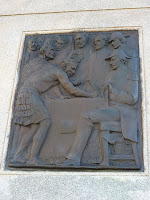
I tried this after lunch with varying success - I'll need to pick Keith's brain some more I think. The statue of Victoria has some really nice panels on the side of it and one was of the signing of the treaty of Waitangi. What this panel is evidence of is that society at the beginning of the 20th century thought that the relationship between Maori and Europeans was completely unproblematic. Maori had ceded sovereignty and Queen Victoria had reigned benignly. This, of course seriously misrepresents history! It was interesting talking to students about this panel and the fact that it tells us almost nothing about the Treaty of Waitangi itself. If we want to know who signed it and why, who didn't sign it and why, what was promised and what wasn't and what the consequences of the Treaty were we would have to go to a different source.
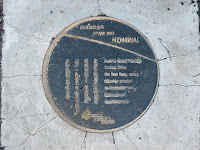
Many students thought the Haining St plaque was a bit lame given the viciousness of that hate crime. One pointed out that a similar plaque in the Basin Reserve commemorating the record number of 6s hit in a cricket innings was quite a lot bigger. On Keith's advice, I asked them what it would tell a class in 100 years time about people today (the plaque is a very recent addition to the memorial landscape). That generated a bit of interesting discussion. I thought it might represent the move to apologize for past wrong doings. Whether that be for the treatment of aboriginies, Maori, Chinese, Samoans, slaves etc... What does that say about us today? Using history to contextualise the present is a really good thing to do but it is also probably the hardest. Both groups pointed out that on the plaque to Joe Kum Yung the "Absolutely Positively Wellington" logo appeared ironic given what was being remembered. One even pointed out that the logo was bigger than the name of the man killed. One perceptive comment was that might be due to contemporary commercialism.
After the trip all students received their 1.1 research assignment and now they are about to start researching a memorial. Several have rejected the 5 I suggested which is great - and some have started to develop some really good other ideas. This is a remarkably easy way to get students interested in New Zealand history and social history too. Over time it will be good to develop a resource bank of primary sources relating to the events/people remembered as well as stories of their construction. I am especially interested in the story behind the Parihaka memorial. It would be great to use this as a starting point to teach about Parihaka in the manner Richard Manning describes in his recent PhD "Place, Power and Pedagogy: A critical analysis of the status of te Atiawa histories of place in Port Nicholson Block secondary schools and the possible application of place-based education models". There is some pretty interesting stuff in this thesis which I will need to spend a lot more time on.
Long term I would like to have some year 11 students researching the historical context of a particular memorial and explaining the memorial in light of the times that it emerged from. There are definitely year 11s who can do this. What would also be a bit more complex would be to have students researching the story behind the construction of a particular memorial. There will be many memorials for which that hasn't been done and it would involve students engaging in some genuine primary research. Somewhere like Hypercities would be a great place for students to publish this kind of research.
I found myself doing a lot of talking at each spot when what I really wanted was to use the site as a space for discussion and deliberation. While at the Wakefield memorial, Keith Barton, the visiting US academic who is back in town for a week, found us and I asked him how might I extract historical thinking from a memorial. His first suggestion was to ask students what the places are evidence of. Memorials, as historical interpretations, tell us far more about the people who constructed them than the actual events or people that they portray.

I tried this after lunch with varying success - I'll need to pick Keith's brain some more I think. The statue of Victoria has some really nice panels on the side of it and one was of the signing of the treaty of Waitangi. What this panel is evidence of is that society at the beginning of the 20th century thought that the relationship between Maori and Europeans was completely unproblematic. Maori had ceded sovereignty and Queen Victoria had reigned benignly. This, of course seriously misrepresents history! It was interesting talking to students about this panel and the fact that it tells us almost nothing about the Treaty of Waitangi itself. If we want to know who signed it and why, who didn't sign it and why, what was promised and what wasn't and what the consequences of the Treaty were we would have to go to a different source.

Many students thought the Haining St plaque was a bit lame given the viciousness of that hate crime. One pointed out that a similar plaque in the Basin Reserve commemorating the record number of 6s hit in a cricket innings was quite a lot bigger. On Keith's advice, I asked them what it would tell a class in 100 years time about people today (the plaque is a very recent addition to the memorial landscape). That generated a bit of interesting discussion. I thought it might represent the move to apologize for past wrong doings. Whether that be for the treatment of aboriginies, Maori, Chinese, Samoans, slaves etc... What does that say about us today? Using history to contextualise the present is a really good thing to do but it is also probably the hardest. Both groups pointed out that on the plaque to Joe Kum Yung the "Absolutely Positively Wellington" logo appeared ironic given what was being remembered. One even pointed out that the logo was bigger than the name of the man killed. One perceptive comment was that might be due to contemporary commercialism.
After the trip all students received their 1.1 research assignment and now they are about to start researching a memorial. Several have rejected the 5 I suggested which is great - and some have started to develop some really good other ideas. This is a remarkably easy way to get students interested in New Zealand history and social history too. Over time it will be good to develop a resource bank of primary sources relating to the events/people remembered as well as stories of their construction. I am especially interested in the story behind the Parihaka memorial. It would be great to use this as a starting point to teach about Parihaka in the manner Richard Manning describes in his recent PhD "Place, Power and Pedagogy: A critical analysis of the status of te Atiawa histories of place in Port Nicholson Block secondary schools and the possible application of place-based education models". There is some pretty interesting stuff in this thesis which I will need to spend a lot more time on.
Long term I would like to have some year 11 students researching the historical context of a particular memorial and explaining the memorial in light of the times that it emerged from. There are definitely year 11s who can do this. What would also be a bit more complex would be to have students researching the story behind the construction of a particular memorial. There will be many memorials for which that hasn't been done and it would involve students engaging in some genuine primary research. Somewhere like Hypercities would be a great place for students to publish this kind of research.
Thursday, February 11, 2010
Memorial Project posting 2
It has been the end of another week working up to the student's first major project on memorials. I think it was Karl Popper who said "never answer unasked questions". There has been a bit of me asking unasked questions this week and there hasn't been quite the same sense of momentum as, say, my social studies class where every activity has seemed to unfold from the previous one and into the next lesson in a way that my social studies teaching hasn't quite cohered before. As one of my students pointed out, we need to get our teeth into something. There has been some interesting discussion about the nature of history and memory and how the past is remembered. It has also been good to see that students in their journals are starting to notice memorials a bit more and reflect on their role as cultural markers. However, in my attempt to underpin the classes with "historical thinking" it has come at the expense of having a real reason to do this.
But you live and learn. Keith Barton, the U.S academic is back in town this week to do some research in my classroom and a couple of other schools. We have asked him to inquire into students' understanding of Agency, Perspective, and Evidence and to see if there are any changes in students' understanding of these concepts over the year before he comes back towards the end of the year. That should keep me on my toes. I kind of want there to be some discernible difference! My probings so far have revealed some interesting ideas about the past, for example:
- People in the past didn't think as much as people in the present
- Learning about racism in the past might actually make it worse today
- And there is a real sense that the criteria for something to be of historical significance requires it to be about "people who have made a difference" and political events.
I would really like to do a topic on the everyday life of a community completely different from our own and in the students' journals there is an interest in ancient Rome and Medieval Europe. When I lived in Germany on a student exchange I learnt more about New Zealand than I did Germany in many respects. I wonder if the same can work in history. If we learn about a way of life really different and look for similarities and differences, perhaps we can better understand and evaluate society today and the kind of world we want to live in. The main thing I want to discuss with Keith is the difference between history and social studies. Identifying a "problem" or "social issue" seems easier when it is occurring today than for history and I don't want history education to be solely about understanding the roots of contemporary events, as laudable as that goal is.
Anyway, memorials. The intention was to go and visit the five I have selected and I would tell them a bit about the person or event that it represented to try and get them thinking about which they might choose - if any of them. Unfortunately it rained so only one class got out so I only got to the Parihaka Prisoner memorial and the National War Memorial. Earlier in the week I had found a section from Jock Philips and Chris McLean's book on NZ war memorials and there was a really interesting section from someone who was writing shortly after World War One about the disgrace in the way we make memorials beautiful when they should be hideously ugly to remind us about the true nature of war. This fits with Jay Winter's thesis that memorials are as much about forgetting as they are remembering. Many students agreed with the general idea - what would be important to get across next time is just how privileged that viewpoint is. Only in peace time and without the imminent threat of war or the pressure nationalist jingoism can we so easily reject war. It would be cool if some students looked at the agency of people who disagreed with the decision to go to war and the structural conditions they faced and that made their lives so difficult and, of course, the agency of soldiers who enlisted prior to 1916 conscription.
Most seem to be enjoying the field trips. Next week I will finish them and they will need to decide on a person, event, or issue to research that is represented in a local Memorial. Today 40kg worth of clay was dropped off on my desk. It is so great working in a school which can resource the kind of teaching I am doing. I am looking forward to the lesson when having completed the research they have to mold the clay to represent the person/issue/event in the manner they think more appropriate or at the very least, different. I like the idea of literally molding an idea into a form for others to see in an artistic sense. Looking through their journals, there are a lot of students whose favourite school subjects are art and drama. This I will need to use to my advantage....
But you live and learn. Keith Barton, the U.S academic is back in town this week to do some research in my classroom and a couple of other schools. We have asked him to inquire into students' understanding of Agency, Perspective, and Evidence and to see if there are any changes in students' understanding of these concepts over the year before he comes back towards the end of the year. That should keep me on my toes. I kind of want there to be some discernible difference! My probings so far have revealed some interesting ideas about the past, for example:
- People in the past didn't think as much as people in the present
- Learning about racism in the past might actually make it worse today
- And there is a real sense that the criteria for something to be of historical significance requires it to be about "people who have made a difference" and political events.
I would really like to do a topic on the everyday life of a community completely different from our own and in the students' journals there is an interest in ancient Rome and Medieval Europe. When I lived in Germany on a student exchange I learnt more about New Zealand than I did Germany in many respects. I wonder if the same can work in history. If we learn about a way of life really different and look for similarities and differences, perhaps we can better understand and evaluate society today and the kind of world we want to live in. The main thing I want to discuss with Keith is the difference between history and social studies. Identifying a "problem" or "social issue" seems easier when it is occurring today than for history and I don't want history education to be solely about understanding the roots of contemporary events, as laudable as that goal is.
Anyway, memorials. The intention was to go and visit the five I have selected and I would tell them a bit about the person or event that it represented to try and get them thinking about which they might choose - if any of them. Unfortunately it rained so only one class got out so I only got to the Parihaka Prisoner memorial and the National War Memorial. Earlier in the week I had found a section from Jock Philips and Chris McLean's book on NZ war memorials and there was a really interesting section from someone who was writing shortly after World War One about the disgrace in the way we make memorials beautiful when they should be hideously ugly to remind us about the true nature of war. This fits with Jay Winter's thesis that memorials are as much about forgetting as they are remembering. Many students agreed with the general idea - what would be important to get across next time is just how privileged that viewpoint is. Only in peace time and without the imminent threat of war or the pressure nationalist jingoism can we so easily reject war. It would be cool if some students looked at the agency of people who disagreed with the decision to go to war and the structural conditions they faced and that made their lives so difficult and, of course, the agency of soldiers who enlisted prior to 1916 conscription.
Most seem to be enjoying the field trips. Next week I will finish them and they will need to decide on a person, event, or issue to research that is represented in a local Memorial. Today 40kg worth of clay was dropped off on my desk. It is so great working in a school which can resource the kind of teaching I am doing. I am looking forward to the lesson when having completed the research they have to mold the clay to represent the person/issue/event in the manner they think more appropriate or at the very least, different. I like the idea of literally molding an idea into a form for others to see in an artistic sense. Looking through their journals, there are a lot of students whose favourite school subjects are art and drama. This I will need to use to my advantage....
Friday, February 5, 2010
Memorial Project posting 1
For this project I want explore with students the role of memory in society and the kinds of historical markers humans create to maintain certain memories in certain ways and not others. Jock Phillip’s idea that memorials are “historiography in stone” is a really provocative one. It seems that the way we remember the past says a whole lot about the values of people in the past and the present and the connection between the two. The role of legacy, which seems to be one of the more interesting and controversial concepts in history education becomes important. Our cultural landscape is strewn with the names of people and events, which represent attitudes, politics and beliefs that we would probably no longer accept as being particularly worthy. By us naming the landscape like this do we somehow perpetuate these attitudes and values? For example, it is very obvious that Queen Victoria and the Empire she represented was a very important person in Wellingtonian’s cultural psyche. We name a University, a large hill, a suburb and large a tunnel after Victoria and of course there is a fabulous statue of her on Cambridge Tce. Do we still support the colonizing values of an empire that subjugated so many people, alienated so many people from their lands, was absolutely convinced of their own cultural superiority and was complicit in trans-Atlantic slavery? These are quite interesting questions and one of my goals for this unit is for students to start noticing these associations and at the very least being able to discuss them in an informed manner.
I gave students the question “How do we remember the past in our local community” and sent them out in groups with a digital camera. They took photos of street signs, the names of tunnels, war memorials, a piece of local graffiti which commemorates a local musician and is repainted every time the council paints over it, an old Volkswagen car, old photographs and plaques of the school, a sculpture of a WW1 medic and his donkey, a memorial to some prisoners, a poster of the Treaty of Waitangi, a gate to a sports field with a name engraved into it, me (as a history teacher!), an old crest on Government house, the school name and a few more.
During lunch I downloaded their findings into a folder and next period students explained what and where the photo was taken and what they thought it said about the cultural values of people in past and present. That proved a little hard for all the photos and we needed to discuss their findings in relation to what counts as historically significant. We also need to develop some criteria for that. For example the unofficial graffiti, while it may have an entry on Wikipedia, is significant only with in a small circle of people. And the plaque of the founding of the school may be interesting to an historian of the school but ultimately it isn’t all that interesting. We did get some good discussion and one student made the comment that once you start thinking about how the past is remembered you start to see examples everywhere. We talked about the different types of memorials, for example, unofficial ones, ones to specific people and events or to what an event represented. It was interesting talking about whether or not there should be a memorial to a local teenager who was murdered by two people who objected to his sexual orientation. Overall the discussion was quite good but with lots of potential for more sophistication and complexity.
Then I asked them to write a short statement explaining how the past was remembered in the local community. Some students just listed the different ways, for example, memorials, street names and plaques. So I asked them to do this in relation to some questions I had given them on the assignment sheet, which asked “whose stories are remembered and whose are not”. That helped. One student said people who are powerful, men and those “further up the social hierarchy” are remembered. Another made a comment that this is because the way society is and it is unlikely that the people who didn’t make a big difference would be remembered in the way these people were. This suggests that their notions of ‘historical significance’ might be limited to political history and powerful individuals. I might need to explore this further with them. Social history and the role of citizen dissent and disobedience in society is an important issue to discuss. How likely would it be for a sizable memorial to be established near the National War Memorial (or as part of it?!) that commemorated the efforts of WW1 and WW2 conscientious objectors? What does the unliklihood tell us about the society we live in and our involvement and reaction to war? This could lead to a discussion about New Zealand sending elite troops to Afghanistan, also a war not without its controversy!
Last period I had my other history class which was much bigger and for a Friday period 5 on a stinking hot summer’s day much more unsettled. I hardly blame them! What better activity than to send them outside! And, in one of those great moments that you can’t predict, there was a big memorial service with politicians and representatives from Canada, the U.S and Australia taking place at the National War memorial commemorating 65 years since the end of World War Two. Many were really excited and one student raced back to say they might not get back at the time I said they needed to be. I haven’t seen what they took photos of yet – if they were at a service they might be of all the same thing!
I gave students the question “How do we remember the past in our local community” and sent them out in groups with a digital camera. They took photos of street signs, the names of tunnels, war memorials, a piece of local graffiti which commemorates a local musician and is repainted every time the council paints over it, an old Volkswagen car, old photographs and plaques of the school, a sculpture of a WW1 medic and his donkey, a memorial to some prisoners, a poster of the Treaty of Waitangi, a gate to a sports field with a name engraved into it, me (as a history teacher!), an old crest on Government house, the school name and a few more.
During lunch I downloaded their findings into a folder and next period students explained what and where the photo was taken and what they thought it said about the cultural values of people in past and present. That proved a little hard for all the photos and we needed to discuss their findings in relation to what counts as historically significant. We also need to develop some criteria for that. For example the unofficial graffiti, while it may have an entry on Wikipedia, is significant only with in a small circle of people. And the plaque of the founding of the school may be interesting to an historian of the school but ultimately it isn’t all that interesting. We did get some good discussion and one student made the comment that once you start thinking about how the past is remembered you start to see examples everywhere. We talked about the different types of memorials, for example, unofficial ones, ones to specific people and events or to what an event represented. It was interesting talking about whether or not there should be a memorial to a local teenager who was murdered by two people who objected to his sexual orientation. Overall the discussion was quite good but with lots of potential for more sophistication and complexity.
Then I asked them to write a short statement explaining how the past was remembered in the local community. Some students just listed the different ways, for example, memorials, street names and plaques. So I asked them to do this in relation to some questions I had given them on the assignment sheet, which asked “whose stories are remembered and whose are not”. That helped. One student said people who are powerful, men and those “further up the social hierarchy” are remembered. Another made a comment that this is because the way society is and it is unlikely that the people who didn’t make a big difference would be remembered in the way these people were. This suggests that their notions of ‘historical significance’ might be limited to political history and powerful individuals. I might need to explore this further with them. Social history and the role of citizen dissent and disobedience in society is an important issue to discuss. How likely would it be for a sizable memorial to be established near the National War Memorial (or as part of it?!) that commemorated the efforts of WW1 and WW2 conscientious objectors? What does the unliklihood tell us about the society we live in and our involvement and reaction to war? This could lead to a discussion about New Zealand sending elite troops to Afghanistan, also a war not without its controversy!
Last period I had my other history class which was much bigger and for a Friday period 5 on a stinking hot summer’s day much more unsettled. I hardly blame them! What better activity than to send them outside! And, in one of those great moments that you can’t predict, there was a big memorial service with politicians and representatives from Canada, the U.S and Australia taking place at the National War memorial commemorating 65 years since the end of World War Two. Many were really excited and one student raced back to say they might not get back at the time I said they needed to be. I haven’t seen what they took photos of yet – if they were at a service they might be of all the same thing!
Monday, February 23, 2009
Interpreting primary sources
As an entry into the year 11 course on the Israel/Palestine conflict I have started with a whole lot of primary sources generated around and during the recent invasion/assault/slaughter/crisis of Gaza (depends which news agency you look at) and have asked students to interpret them to write 'a short history of the 'assault...' on Gaza'. The intention is to show that all historical narratives are based on the interpretations of primary sources and open to constant reevaluation. But also to teach them how history is an evidenced-based subject; if you are going to make a claim, have a good reason to make it. The other intention, of course, is to show students how you can't really understand this event without a much broader knowledge of Middle East history. I think I started with far too many sources which bamboozled a few of them, but there were some excellent discussions about what 'historical truth' is, and how to deal with conflicting sources. However, had I done this again I would:
Pretty soon they are starting their research assignments where they have to show how history is important to the present. I am planning on a couple of periods per week for 3-4 weeks to be in the library with the other two periods carrying on with the long term causes of the Israel/Palestine conflict. It will be interesting to see whether this works without confusing them too much. I am hoping that together we can learn how an historical understanding of the Israel/Palestine conflict is essential to understand the present situation which will at the same time provide a model for their own research. Some have some excellent ideas which I will write about once they have been firmed up. One thing that has become clearer to me than it has in the past, is that research, done well, takes a lot of time. They need time to decide on a topic, read around it, develop some research questions, do the research, take notes, possibly rejig a question, write up a draft, have it peer edited, write the final copy and have it published in an authentic manner as possible. Weeks of hard learning!
- Have fewer sources - it was too overwhelming for some to select from a multitude of maps, photographs, graphs, newspaper clippings, internet printouts etc...
- Break down the task requirement more. The first thing they should have done is to decide, based on the sources, what to call their short history (was it a slaughter? Crisis? Assault? Crime? Offensive? Attack?) and to give reasons for this. It would have been a nice little exercise to hand in.
- Be more explicit early on with the difference between long term and short term causes. Perhaps have had a few long term causes in their primary source pack.
Pretty soon they are starting their research assignments where they have to show how history is important to the present. I am planning on a couple of periods per week for 3-4 weeks to be in the library with the other two periods carrying on with the long term causes of the Israel/Palestine conflict. It will be interesting to see whether this works without confusing them too much. I am hoping that together we can learn how an historical understanding of the Israel/Palestine conflict is essential to understand the present situation which will at the same time provide a model for their own research. Some have some excellent ideas which I will write about once they have been firmed up. One thing that has become clearer to me than it has in the past, is that research, done well, takes a lot of time. They need time to decide on a topic, read around it, develop some research questions, do the research, take notes, possibly rejig a question, write up a draft, have it peer edited, write the final copy and have it published in an authentic manner as possible. Weeks of hard learning!
Friday, February 6, 2009
The key competencies and teaching history
Having spent a year experimenting with the new curriculum and integrating the four core junior subjects with 3 other teachers in 2008 it has been interesting to see how that thinking has affected the way I approach the senior subjects. I have completely overhauled year 11 history, following Rosemary Hipkin’s advice to use the key competencies as lenses on the senior subjects to ‘see what happens’.
It was awkward reading Keith Barton and Linda Levstik’s book “Teaching History for the Common Good” over summer for two reasons. First, in four years as a history teacher it was the first book on teaching history I had picked up and second, because their description of the reasons for teaching history that plagues many (most?) history classrooms felt very familiar. The reasons they identified were: (i) maintain control, (ii) cover the curriculum. Below is what I have written for students to expect in the first term as a response to this situation:
Behind the headlines – using the past to make sense of current events
One of the most important reasons for studying history is the perspective that historical knowledge can bring to current events. Without understanding the historical roots of, for example, the Israeli offensive on Gaza in January 2009, it is very difficult to participate in reasoned discussion about what should be done or how nations, organizations and individuals should act. The “Behind the headlines” assignment gives you the opportunity to select and research any current event you care about and research how an historical understanding of this problem will better enable you and other young people to understand it. The research you do will be published in a combined year 11 history magazine for students at school. The exact nature of this publication will be negotiated between the two history classes and could involve multi media such as pod casts or video clips uploaded to YouTube with the link in the publication. To get the ball rolling this unit will start by all of us looking at what problems of world significance are present in the Middle East, most significantly, the Israeli/Palestinian conflict. We will spend some time looking at how historical knowledge of this issue is essential for understanding before you can choose your own line of inquiry for the class newspaper.
Having spent a lesson with the students on what they know I have been surprised at what some students don’t know about the Israel/Palestine conflict. Not so much about the conflict in general, but about the Israeli invasion of Gaza in January. Perhaps I should be pleased that they weren’t paying much interest to the television network news, which barely counts as news, and I hadn’t expected them to be trawling through Israeli and other international newspaper websites, blogs and opinion pieces, or following the terrifyingly live Twitter updates on Al Jazeera’s website, but the experience highlighted how important my approach for term one is, assuming it works. It is essential to understand the historical context of current issues if we are to understand and take part in intelligent conversation, or respond in more active, participatory and democratic ways. I will just need to spend more time than I thought on teaching the actual current issues before the history than I thought. Ronald Wright, historian and author of "What is America: A short history of the New World Order" captures the importance of this perfectly:
As a part of this assignment I also want to bring in some guest speakers, and my ideas had been to get in some interesting, local and opinionated people to talk and rark the students up a bit before we deconstruct the validity of their ideas. I met with a local rabbi for advice on how to approach this topic, and it was gently pointed out to me that it would be better to start with the middle ground with guest speakers, or at the very least have real Palestinians and Israelis talk rather than the plenty of people available with their own opinions, valid or otherwise. Focusing on the extremes, you teach students that the issue is about extremes (irreconcilable ones at that) and that history is black and white and essentially simple. This, of course, is anathema to the discipline of history let alone the understanding needed for democratic participation. History is nuanced, contextual, objective, and highly complex; none of which says you can’t take an ethical stance on an issue. Being “moderate” doesn’t mean you can't totally deplore the Israeli Defence Force's killing of 100s of civilian children and their parents in Gaza. The quote that stood out the most from Barton and Levstik’s book is “the ultimate purpose of history education, in our view, is to enable students to take action in the present”. So, a focus on understanding current events from an historical perspective, the product of which will be peer reviewed articles published together for other students is my initial response to the key competencies of Thinking, Using language, symbols, and texts, Managing self, Relating to others and Participating and contributing. It is scary but kind of exciting to start using history for real issues other than some nostalgic, humanistic idea that reading history is good for the soul - or instead a bureaucratic-technocratic purpose that you maintain control and have them pass the exam so students can cash the knowledge in for credits and later contribute to the economy. As Neil Postman says, such a purpose for education “mocks ones humanity” and should be a by-product, not a reason for education.
It was awkward reading Keith Barton and Linda Levstik’s book “Teaching History for the Common Good” over summer for two reasons. First, in four years as a history teacher it was the first book on teaching history I had picked up and second, because their description of the reasons for teaching history that plagues many (most?) history classrooms felt very familiar. The reasons they identified were: (i) maintain control, (ii) cover the curriculum. Below is what I have written for students to expect in the first term as a response to this situation:
Behind the headlines – using the past to make sense of current events
One of the most important reasons for studying history is the perspective that historical knowledge can bring to current events. Without understanding the historical roots of, for example, the Israeli offensive on Gaza in January 2009, it is very difficult to participate in reasoned discussion about what should be done or how nations, organizations and individuals should act. The “Behind the headlines” assignment gives you the opportunity to select and research any current event you care about and research how an historical understanding of this problem will better enable you and other young people to understand it. The research you do will be published in a combined year 11 history magazine for students at school. The exact nature of this publication will be negotiated between the two history classes and could involve multi media such as pod casts or video clips uploaded to YouTube with the link in the publication. To get the ball rolling this unit will start by all of us looking at what problems of world significance are present in the Middle East, most significantly, the Israeli/Palestinian conflict. We will spend some time looking at how historical knowledge of this issue is essential for understanding before you can choose your own line of inquiry for the class newspaper.
Having spent a lesson with the students on what they know I have been surprised at what some students don’t know about the Israel/Palestine conflict. Not so much about the conflict in general, but about the Israeli invasion of Gaza in January. Perhaps I should be pleased that they weren’t paying much interest to the television network news, which barely counts as news, and I hadn’t expected them to be trawling through Israeli and other international newspaper websites, blogs and opinion pieces, or following the terrifyingly live Twitter updates on Al Jazeera’s website, but the experience highlighted how important my approach for term one is, assuming it works. It is essential to understand the historical context of current issues if we are to understand and take part in intelligent conversation, or respond in more active, participatory and democratic ways. I will just need to spend more time than I thought on teaching the actual current issues before the history than I thought. Ronald Wright, historian and author of "What is America: A short history of the New World Order" captures the importance of this perfectly:
"History is the best guide we have for threading our way through the frenetic video game of current events. As the game speeds up, with runaway technological and social change, the great risk is that both the old and the young become isolated, in different ways, by the parochialism of the present: one generation gets marooned, the next swept along without a ship's log or rudder." (p.14).
As a part of this assignment I also want to bring in some guest speakers, and my ideas had been to get in some interesting, local and opinionated people to talk and rark the students up a bit before we deconstruct the validity of their ideas. I met with a local rabbi for advice on how to approach this topic, and it was gently pointed out to me that it would be better to start with the middle ground with guest speakers, or at the very least have real Palestinians and Israelis talk rather than the plenty of people available with their own opinions, valid or otherwise. Focusing on the extremes, you teach students that the issue is about extremes (irreconcilable ones at that) and that history is black and white and essentially simple. This, of course, is anathema to the discipline of history let alone the understanding needed for democratic participation. History is nuanced, contextual, objective, and highly complex; none of which says you can’t take an ethical stance on an issue. Being “moderate” doesn’t mean you can't totally deplore the Israeli Defence Force's killing of 100s of civilian children and their parents in Gaza. The quote that stood out the most from Barton and Levstik’s book is “the ultimate purpose of history education, in our view, is to enable students to take action in the present”. So, a focus on understanding current events from an historical perspective, the product of which will be peer reviewed articles published together for other students is my initial response to the key competencies of Thinking, Using language, symbols, and texts, Managing self, Relating to others and Participating and contributing. It is scary but kind of exciting to start using history for real issues other than some nostalgic, humanistic idea that reading history is good for the soul - or instead a bureaucratic-technocratic purpose that you maintain control and have them pass the exam so students can cash the knowledge in for credits and later contribute to the economy. As Neil Postman says, such a purpose for education “mocks ones humanity” and should be a by-product, not a reason for education.
Subscribe to:
Posts (Atom)