Social studies is all about the critical understanding of relevant social issues. Social studies units about these issues should be underpinned by a "conceptual understanding" or a "big idea" about society. Students used newspaper clippings to come up with the overall theme of "Apocalypse Theories" which meant that they were engaged from the beginning which was great. But it took weeks of me reading and researching and a social sciences faculty meeting to develop a conceptual understanding that would have better tied everyone's exhibits together. As a faculty the social sciences teachers came up with "How societies use apocalyptic thinking helps us to understand their cultural values". Had I been thinking along these lines earlier we could have looked at a real social issue, such as the way some fundamentalist Christians require certain conditions in Israel to take place before the Apocalypse and Second coming and the potential consequences for Palestinians of this kind of support. In depth exploration of this sort of solid, real-world issue could have served as the vehicle for the conceptual understanding above.
Students have learnt a lot about inquiry but next time I will work on developing a more focused social issue at the heart of the unit, instead of fairly traditional social studies lessons on, for example, the Cold War and nuclear proliferation. This way, even if students aren't successful with coming up with a great exhibition display, at least I can still be sure they have developed their conceptual understanding of an important social issue. Next year it will be good to exhibit students' learning on a website instead of an open evening for parents. They could advertise a launch date, and have a goal of the number of hits to the site.

Tuesday, November 9, 2010

Monday, November 8, 2010
Apocalypse Theories Post 9
It has been a long time since the last post and this Thursday is the big day. Students have been working pretty hard and it has been interesting to see which groups have survived and which haven't; also which ones have used presentation to delay in-depth research. I can totally relate to them doing this, but in the end an inquiry has to result in a high quality product.
Inquiry is a disposition, an attitude towards knowledge and I think that everyone, even if what they produced is not that complex, will be able to do some really good critical reflection on themselves after the exhibition. Here is a quote that I have often thought of for this inquiry:
"A phenomenon will persist until the effort required to maintain it exceeds the effort required to revise it" (Davis, Luce and Sumara, p.108)
This is an idea central to constructivism. I have especially noticed this with students' note-taking. I have given workshops on how to do this and explained that if their research is to be complex they will have needed to read and noted potentially useful information from many sources, as they search and revise their inquiry question and the only realistic way to do this is to take good notes. Very few students actually believe me. If this quote is to be taken seriously the teacher's job is to create the conditions whereby the effort to maintain this anti-note-taking mindset is too much. Perhaps for some of them this assignment has helped them get to that place, but this is the only way students learn. It has been interesting to observe students continually updating and "construing" (the better translation from the French word construct") their understandings of the world. It took one student 15 weeks to admit he couldn't really do research. That is a valuable 15 weeks if you ask me. Some people never arrive at that conclusion. If they do it before year 11 more's the better.
The student's last inquiry was done with booklets with 6 inquiry steps. This was a useful exercise in many ways and the language of the steps has also helped students with this inquiry. But if students can only do inquiry if we provide them with booklets they haven't actually learnt anything significant. The school's quided inquiry process is for many students very useful but if they don't learn that inquiry is an attitude, an orientation towards knowledge, they haven't learnt anything significant at all.
Many students I think are starting to realise this; as the quote suggests about learning, they are realizing that their preconceived ideas about "research" don't really work and they could do with updating. That has probably been the highlight of this whole exercise. Piaget was on to it.
If we were to do it again I would need to think how I could better incorporate a central idea about society. I have struggled to work out how to have a really strong inquiry running alongside a really strong social studies curriculum that is based on an issue that students have participated in developing. This last thought will be the topic of the last blog.
Inquiry is a disposition, an attitude towards knowledge and I think that everyone, even if what they produced is not that complex, will be able to do some really good critical reflection on themselves after the exhibition. Here is a quote that I have often thought of for this inquiry:
"A phenomenon will persist until the effort required to maintain it exceeds the effort required to revise it" (Davis, Luce and Sumara, p.108)
This is an idea central to constructivism. I have especially noticed this with students' note-taking. I have given workshops on how to do this and explained that if their research is to be complex they will have needed to read and noted potentially useful information from many sources, as they search and revise their inquiry question and the only realistic way to do this is to take good notes. Very few students actually believe me. If this quote is to be taken seriously the teacher's job is to create the conditions whereby the effort to maintain this anti-note-taking mindset is too much. Perhaps for some of them this assignment has helped them get to that place, but this is the only way students learn. It has been interesting to observe students continually updating and "construing" (the better translation from the French word construct") their understandings of the world. It took one student 15 weeks to admit he couldn't really do research. That is a valuable 15 weeks if you ask me. Some people never arrive at that conclusion. If they do it before year 11 more's the better.
The student's last inquiry was done with booklets with 6 inquiry steps. This was a useful exercise in many ways and the language of the steps has also helped students with this inquiry. But if students can only do inquiry if we provide them with booklets they haven't actually learnt anything significant. The school's quided inquiry process is for many students very useful but if they don't learn that inquiry is an attitude, an orientation towards knowledge, they haven't learnt anything significant at all.
Many students I think are starting to realise this; as the quote suggests about learning, they are realizing that their preconceived ideas about "research" don't really work and they could do with updating. That has probably been the highlight of this whole exercise. Piaget was on to it.
If we were to do it again I would need to think how I could better incorporate a central idea about society. I have struggled to work out how to have a really strong inquiry running alongside a really strong social studies curriculum that is based on an issue that students have participated in developing. This last thought will be the topic of the last blog.
Thursday, September 2, 2010
Apocalypse Theories Post 9
Students have spent the week working on their proposals. They also had to complete a progress report ready for Monday outlining their inquiry question, what they have done so far, their next steps and any problems they have encountered. It has been good seeing the vast majority self-organise and manage their time, especially since we have a double period of two hours. Some students have demonstrated more engagement in the last 4 periods than all the year's classes combined.
My next entry is going to be after some thinking about what Michael Young calls "Powerful Knowledge" and how it might apply to what my students are doing in class at the moment.
My next entry is going to be after some thinking about what Michael Young calls "Powerful Knowledge" and how it might apply to what my students are doing in class at the moment.
Sunday, August 22, 2010
Apocalypse Theories Post 8
I designed an "Apocalypse Theories Exhibition Proposal" booklet for students to fill in which included making "SMART" goals for three periods. Upon collecting them in there are still very few students who have got to a position where they have practical things to carry on with. Making an action plan is a very hard task and one they will still need lots of help with. There is lots of potential in many of their proposals and also evidence of what looks like a completely wasted 90 minutes of social studies for others. Is it because we have taught students to become so dependent on teachers that they are struggling so much? It is all very interesting anyway. Shifting the division of labour away from me so we are all active participants working towards a common goal is going to require a cultural shift in our class, but one that I am sure they are all up for. I have written in a whole lot of feedback on their proposals so the next test is to see the extent to which they take it on board.
What I am enjoying is the beginnings of the "French Pass Effect". At school camp, for 6 awesome days it feels like everyone forgets who is supposedly more intelligent than anyone else. There is an appreciation that everyone has different strengths in different contexts.
Anyway, what I really want to write about is Zombies. A bunch of students still really want to do this topic so I have said they need a water tight proposal before I accept their idea. After a short google search it does seem like a perfectly plausible topic. I have found one blog article which refers to the cranberries song "Zombies" in the following way:
"I think this music video is very telling of both the influence of zombies into modern popular culture and on the principles that zombies represent. The band decided to name their hit song after the famed ghouls because they portray the militants in Ireland, being told to patrol violently and following orders without regard for humanity. In this way, zombies often come to mind when thinking of people blindly doing things, whether violent, like Nazis, or whether innocently, like following the trends of consumer culture (such as the representation of the mall in Romero’s Dawn of the Dead). I thought this was really interesting to see how zombies in America have evolved from being simply flesh-eating monsters to entire symbols of mindless following."
Such an approach could easily lend itself to a sensible contribution to an exhibition on Apocalypse theories. I also found a great guardian article in the science section titled 'Zombie ants' controlled by parasitic fungus for 48m years. It is pretty amazing and I guess it would involve some science to explore if this could happen to humans, or more to the point, I expect, why it couldn't. There is also evidence that our culture's obsession with zombies also stems from early encounters between European explorers and Caribbean voodoo cults.
What I am enjoying is the beginnings of the "French Pass Effect". At school camp, for 6 awesome days it feels like everyone forgets who is supposedly more intelligent than anyone else. There is an appreciation that everyone has different strengths in different contexts.
Anyway, what I really want to write about is Zombies. A bunch of students still really want to do this topic so I have said they need a water tight proposal before I accept their idea. After a short google search it does seem like a perfectly plausible topic. I have found one blog article which refers to the cranberries song "Zombies" in the following way:
"I think this music video is very telling of both the influence of zombies into modern popular culture and on the principles that zombies represent. The band decided to name their hit song after the famed ghouls because they portray the militants in Ireland, being told to patrol violently and following orders without regard for humanity. In this way, zombies often come to mind when thinking of people blindly doing things, whether violent, like Nazis, or whether innocently, like following the trends of consumer culture (such as the representation of the mall in Romero’s Dawn of the Dead). I thought this was really interesting to see how zombies in America have evolved from being simply flesh-eating monsters to entire symbols of mindless following."
Such an approach could easily lend itself to a sensible contribution to an exhibition on Apocalypse theories. I also found a great guardian article in the science section titled 'Zombie ants' controlled by parasitic fungus for 48m years. It is pretty amazing and I guess it would involve some science to explore if this could happen to humans, or more to the point, I expect, why it couldn't. There is also evidence that our culture's obsession with zombies also stems from early encounters between European explorers and Caribbean voodoo cults.
Monday, August 16, 2010
Apocalypse Theories Post 7
This morning the main learning intention was to have students create a plan of action for the next 4 periods using the learning wall and all our ideas on it. In short, they needed to outline how they would start the inquiry process. Well it was a bit scary because not much seems to have transferred from the guided inquiry process of Decide, Find, Record, Select, Present and Evaluate. From the action plans of some students the exhibition will be ready for visitors late Friday afternoon!
This is a bit of a hurdle and I am not quite sure how to overcome it because if we go into next period on the basis of the current action plans chaos will surely ensue.
Most students don't have a clear idea about why we are doing this exhibition I think which makes it hard to appeal to an audience. The idea of an exhibition display actually teaching the visitors something is a hard one; perhaps many students don't even fully realise what it means to be "taught" (that's ironic). Maybe we need to deconstruct this further too. Perhaps "provoke" or "make them think" would be better words. Brainstorming synonyms for teaching could be an interesting little exercise.
I guess one thing that will help is getting a few students to survey our potential audience. We really need to do some market research here. A few students visiting some exhibition designers and reporting back will also be of use and we are hopefully going to Te Papa this week too.
Perhaps they all need to do an individual research proposal where they write down their "rich question", a statement about why they think it is of significance or actually important to invest time into, key sources they will draw from, a statement about how their topic will juggle the hope and despair aspect of apocalypse, and a rough time line for completion. Based on today's time line this will be hopelessly inaccurate but it gives us something to reflect on.
This is a bit of a hurdle and I am not quite sure how to overcome it because if we go into next period on the basis of the current action plans chaos will surely ensue.
Most students don't have a clear idea about why we are doing this exhibition I think which makes it hard to appeal to an audience. The idea of an exhibition display actually teaching the visitors something is a hard one; perhaps many students don't even fully realise what it means to be "taught" (that's ironic). Maybe we need to deconstruct this further too. Perhaps "provoke" or "make them think" would be better words. Brainstorming synonyms for teaching could be an interesting little exercise.
I guess one thing that will help is getting a few students to survey our potential audience. We really need to do some market research here. A few students visiting some exhibition designers and reporting back will also be of use and we are hopefully going to Te Papa this week too.
Perhaps they all need to do an individual research proposal where they write down their "rich question", a statement about why they think it is of significance or actually important to invest time into, key sources they will draw from, a statement about how their topic will juggle the hope and despair aspect of apocalypse, and a rough time line for completion. Based on today's time line this will be hopelessly inaccurate but it gives us something to reflect on.
Thursday, August 12, 2010
Apocalypse Theories Post 6
Today was an interesting experience. There were a few things going down in the year 9 class and I could feel that a lesson of high-trust, openness and difficulty was not quite going to cut it. I played them a documentary about New Zealand's anti-nuclear position so the have been introduced to a whole lot of ideas about different apocalypse theories which they will need to choose from next week. The level of engagement with the documentary was amazing - I only wanted to play 10 minutes but we ended up going for the whole 50 minutes or so. The period after lunch was the one that they really needed some clear parameters around though.
I had an activity ready with a learning intention something along the lines of "We are learning how to use sources to construct a story about what a nuclear holocaust might be like".
They had to select key information that would help them to write a creative story from the testimony of a Hiroshima survivor, some Hiroshima and Chernobyl photographs and some information from a secondary source giving a broad overview of the Cold War and nuclear bombs. Using this selected information they need to write a one page short story about what a nuclear apocalypse might be like. These of course will be displayed as part of the exhibition. Students need to choose a perspective to write from, such as a male or female, child or adult, a tense, and a time period, either on the first day of the event, a week later or 10,20 or 50 years later. Probably what we need to do is take a look at some really good quality short stories and have a read and integrate that into our own stories too. The English teacher is doing some great debating stuff with them on our topic so I might need to go this alone when otherwise it might have worked to have him look at short stories. The great thing about our integrated learning programme though is that we work closely together so sourcing some short stories from the English Faculty is going to be no big deal at all.
Using the complexity theory idea of providing "enabling constraints" students also needed to include a child's toy, a friendship and a sign of hope in their story. And, of course, it needed to be a story based on some evidence.
Well today that was just the activity they needed. On Monday morning we'll go back to the hard stuff but having this activity up my sleeve prevented a lesson turning into a disaster. God only knows what the dramas were about but they were certainly being a bit weird.
I had an activity ready with a learning intention something along the lines of "We are learning how to use sources to construct a story about what a nuclear holocaust might be like".
They had to select key information that would help them to write a creative story from the testimony of a Hiroshima survivor, some Hiroshima and Chernobyl photographs and some information from a secondary source giving a broad overview of the Cold War and nuclear bombs. Using this selected information they need to write a one page short story about what a nuclear apocalypse might be like. These of course will be displayed as part of the exhibition. Students need to choose a perspective to write from, such as a male or female, child or adult, a tense, and a time period, either on the first day of the event, a week later or 10,20 or 50 years later. Probably what we need to do is take a look at some really good quality short stories and have a read and integrate that into our own stories too. The English teacher is doing some great debating stuff with them on our topic so I might need to go this alone when otherwise it might have worked to have him look at short stories. The great thing about our integrated learning programme though is that we work closely together so sourcing some short stories from the English Faculty is going to be no big deal at all.
Using the complexity theory idea of providing "enabling constraints" students also needed to include a child's toy, a friendship and a sign of hope in their story. And, of course, it needed to be a story based on some evidence.
Well today that was just the activity they needed. On Monday morning we'll go back to the hard stuff but having this activity up my sleeve prevented a lesson turning into a disaster. God only knows what the dramas were about but they were certainly being a bit weird.
Tuesday, August 10, 2010
Apocalypse Theories Post 5
It is going pretty well with our exhibition. We have started to develop a wall with everyone's ideas and shortly we will start allocating tasks and sorting groups out. Students keep volunteering their own or their family's expertise so we need a section where they can put this up. Lots of different "jobs" are emerging too which should go on our learning wall. For example, at least two students have parents who work at Massey University and Te Papa and would have some useful advice about how we could do our exhibition. I want some interested students to go and talk to them, perhaps take some photographs of the classroom space, and then report back to the class. A lot of students are interested in this part so today I asked them to write a justification as to why I should choose them. It may be a case of choosing the best justifications to talk to the adults but then taking the whole class to Te Papa to look at the techniques used for engaging visitors.
Speaking of the audience, this is a really important part of the whole exercise. They have identified who they want to come but I also want them to do their market research. What would teachers/older students/parents want or not want to see at an exhibition about apocalypse theories? An important job will be for a group to find that out and report back.
One student raised an important point - some of the stuff about apocalypse theories is incredibly depressing. He was right - we need to balance a sense of hope with the reality of some theories. I played a 10 minute clip of a documentary about the possibility of a meteorite strike and then asked, if someone was to do this topic, how could we achieve the balance? The same student suggested it could be about "the circle of life". The reason we are here is because the dinosaurs were made extinct through a meteorite strike. No species lasts forever - this is what makes our existence possible. Well, that was pure genius.
I want students to curate this exhibition and decide where displays go and why. Perhaps the team that goes and speaks to the Massey lecturer and Te Papa expert could do this. And we will need an editing team to look at people's text when the time comes.
Speaking of the audience, this is a really important part of the whole exercise. They have identified who they want to come but I also want them to do their market research. What would teachers/older students/parents want or not want to see at an exhibition about apocalypse theories? An important job will be for a group to find that out and report back.
One student raised an important point - some of the stuff about apocalypse theories is incredibly depressing. He was right - we need to balance a sense of hope with the reality of some theories. I played a 10 minute clip of a documentary about the possibility of a meteorite strike and then asked, if someone was to do this topic, how could we achieve the balance? The same student suggested it could be about "the circle of life". The reason we are here is because the dinosaurs were made extinct through a meteorite strike. No species lasts forever - this is what makes our existence possible. Well, that was pure genius.
I want students to curate this exhibition and decide where displays go and why. Perhaps the team that goes and speaks to the Massey lecturer and Te Papa expert could do this. And we will need an editing team to look at people's text when the time comes.
Sunday, August 8, 2010
The Legacy of Waitangi
Keith Barton sent me a draft copy of what he has written about student’s understanding of the Treaty of Waitangi and it brought up a couple of key things. I had asked students what they thought New Zealand was like in the 1830s and we did an activity to deal with the misconceptions, but I didn’t ask them why they thought the Treaty of Waitangi was signed. Barton has found that when asked cold New Zealand students say it was because Maori wanted peace between the races and the Europeans wanted to rip Maori off. Both positions are overly simplistic and, according to Barton, make learning about the Treaty an unpleasant experience for all. Maori students come out thinking that their ancestors were powerless with no agency (of course there is no recognition that not all Maori did in fact sign the Treaty with this interpretation) and European students are made to feel guilty. All other students didn’t have ancestors there so it really is an irrelevant topic for them.
My students have been making posters on the Treaty of Waitangi and the key differences between translations and Maori and European reasons for signing it. Although we had done a class role-play which highlighted a more complex understanding of the event than the two commonly held assumptions, some of the imagery and that they are producing in their posters would suggest that this was a crucial step requiring some carefully chosen sources and activities. For example, one group’s poster had a Maori and Pakeha hand clasped together; a nice idea by two very able students – but missing the true nature of the event.
There are two ways to get around this. First, talking openly about the fact that we are learning about something controversial which we all recognise is often taught badly has proven quite successful so far. So, I have turned Barton’s short draft article critiquing the way the Treaty is taught into a resource which we will read together with lots of rhetorical questions for us to discuss. Secondly, we have touched on enough sources to expose some of the complexity surrounding this event that when we come to evaluate the posters together with my historical thinking rubric, we will be able to undo some of the damage my lack of knowledge has created. It would have been great to have had the historical thinking discussion before we made the posters – the exercise would have been much more of a learning experience.
My students have been making posters on the Treaty of Waitangi and the key differences between translations and Maori and European reasons for signing it. Although we had done a class role-play which highlighted a more complex understanding of the event than the two commonly held assumptions, some of the imagery and that they are producing in their posters would suggest that this was a crucial step requiring some carefully chosen sources and activities. For example, one group’s poster had a Maori and Pakeha hand clasped together; a nice idea by two very able students – but missing the true nature of the event.
There are two ways to get around this. First, talking openly about the fact that we are learning about something controversial which we all recognise is often taught badly has proven quite successful so far. So, I have turned Barton’s short draft article critiquing the way the Treaty is taught into a resource which we will read together with lots of rhetorical questions for us to discuss. Secondly, we have touched on enough sources to expose some of the complexity surrounding this event that when we come to evaluate the posters together with my historical thinking rubric, we will be able to undo some of the damage my lack of knowledge has created. It would have been great to have had the historical thinking discussion before we made the posters – the exercise would have been much more of a learning experience.
Wednesday, August 4, 2010
Apocalypse Theories Post 4
In the last entry I said I had chickened out with giving the power to the students and this would happen only after some more directed teaching. After a lunchtime discussion with a very experienced educator interested in what I am doing, I have decided to trust them. The "more directed teaching" is important, but only in response to an actual need - "never ask unasked questions"! I need a pedagogy of radical trust, although that goes against every teaching instinct. I think it stems from a deep seated fear of young people and "losing control" over them.
Another couple of classes had created an exhibition for the parents the night before which was impressive. We took one class down to see it during period one. Being somewhat dim-witted it only slowly occured to me that "Apocalypse Theories" would make a fantastic exhibition. Fully appreciative of the fact that Alfie Kohn, the legendary crusader against behaviourism, would surely disagree, I appealed to their sense of competition (In my defence, the original meaning of competition is "getting fit together"). I said "I know it's not a competition, but...."..."YES IT IS!!!" they shouted, "we can do much better than that other exhibition!" I had to show the other class photographs rather than take them to view it, but their response was the same.
Back to the lunchtime discussion, the point was made to me that asking students to come up with "activities" they could do was not the best approach. It is an incredibly loaded term. Instead, it was suggested I ask them:
What actions do we need to take to get there?
Who would be our audience?
Why would this be an important exhibition? (who cares?)
What would it look like?
They were pretty keen to get stuck in and although asking them these questions was done on a complete whim - I was going to finish the activity we had started and then try this - we spent the next hour brainstorming ideas. It was a hot, stuffy afternoon in a classroom that would make tinned sardines weep, and all a bit messy - but that's life, not to mention democracy. Their ideas were really good, and as time goes on the participation will get better. Like anything, participation needs to be practiced.
For the four questions (my input in bold)their responses were:
What actions do we need to take?
- We need to find what resources we might need
-We need to work on it at home potentially suspending the homework challenges
-we need to think of the questions we need to answer
- we need to have a brainstorming wall where all our ideas go on it
- We need to take the stuff of the wall that is already there
- We need to get into groups
- We figure out what problem/fear we are actually addressing eg, how to stop it, background info, what happens in it.
Who would be our audience?
Year 13 – address them at assmebly
Parents – send an officail letter from the class, tell them to come.
Voters – posters on the street?
Teachers – personal invitations, hand written names
Other year 9s.
Why would this be an important exhibition?
People are naturally interested in how the world and their own lives might end.
To educate people how to survive or why they they shouldn’t worry eg, what is the science behind 2012?
To educate people how to stop it
What would it look like?
- It would have interaction
- Elis is making a model suitcase nuclear bomb
- Displays need to be 3D like a model
- We need tour guides, exhibition maps
- We could have different areas for different types of apocalypse
- An underground bunker
- We need to address human ‘s primal fears
- We should decorate the narrow hall way up to the classrooms
- We could have an online website for the exhibition that lasts longer than the temporary one
Another couple of classes had created an exhibition for the parents the night before which was impressive. We took one class down to see it during period one. Being somewhat dim-witted it only slowly occured to me that "Apocalypse Theories" would make a fantastic exhibition. Fully appreciative of the fact that Alfie Kohn, the legendary crusader against behaviourism, would surely disagree, I appealed to their sense of competition (In my defence, the original meaning of competition is "getting fit together"). I said "I know it's not a competition, but...."..."YES IT IS!!!" they shouted, "we can do much better than that other exhibition!" I had to show the other class photographs rather than take them to view it, but their response was the same.
Back to the lunchtime discussion, the point was made to me that asking students to come up with "activities" they could do was not the best approach. It is an incredibly loaded term. Instead, it was suggested I ask them:
What actions do we need to take to get there?
Who would be our audience?
Why would this be an important exhibition? (who cares?)
What would it look like?
They were pretty keen to get stuck in and although asking them these questions was done on a complete whim - I was going to finish the activity we had started and then try this - we spent the next hour brainstorming ideas. It was a hot, stuffy afternoon in a classroom that would make tinned sardines weep, and all a bit messy - but that's life, not to mention democracy. Their ideas were really good, and as time goes on the participation will get better. Like anything, participation needs to be practiced.
For the four questions (my input in bold)their responses were:
What actions do we need to take?
- We need to find what resources we might need
-We need to work on it at home potentially suspending the homework challenges
-we need to think of the questions we need to answer
- we need to have a brainstorming wall where all our ideas go on it
- We need to take the stuff of the wall that is already there
- We need to get into groups
- We figure out what problem/fear we are actually addressing eg, how to stop it, background info, what happens in it.
Who would be our audience?
Year 13 – address them at assmebly
Parents – send an officail letter from the class, tell them to come.
Voters – posters on the street?
Teachers – personal invitations, hand written names
Other year 9s.
Why would this be an important exhibition?
People are naturally interested in how the world and their own lives might end.
To educate people how to survive or why they they shouldn’t worry eg, what is the science behind 2012?
To educate people how to stop it
What would it look like?
- It would have interaction
- Elis is making a model suitcase nuclear bomb
- Displays need to be 3D like a model
- We need tour guides, exhibition maps
- We could have different areas for different types of apocalypse
- An underground bunker
- We need to address human ‘s primal fears
- We should decorate the narrow hall way up to the classrooms
- We could have an online website for the exhibition that lasts longer than the temporary one
Tuesday, August 3, 2010
Apocalypse Theories Post 3
We have been working on this unit for about a week now. Before we made our final decision I had the classes evaluate the questions from the previous blog. For one class it went really well and we were able to draw constant parallels with the realities of a real democracy. For example, some students made the point that the process would have worked better if some people had participated in the decision-making process better. The committee was elected from one class and appointed from the other and these 10 students took a whole period to decide on the final topic. They had a bunch of justifications that the class had produced which they needed to consider and I gave them the following brief to follow:
Your job is to choose the topic that you think will serve the class’s interests and educational needs the best. You will need to discuss and debate the 4 choices and look carefully at the pieces of paper you have been given.
Your job IS NOT to convince the rest of the committee what YOU want. As representatives of the class your job is to serve.
You need to justify your response in a short statement and give it to me at the end so I can read it to both classes.
You have the right to ask somebody to leave if you think they are not participating in a way that is in the spirit of democratic decision-making.
They seemed pretty focussed but I was with the actual class rather than the committee for most of the time. It would have been good to have observed more closely how they came to the decision, which was Apocalypse Theories. I don’t know whether they actively discussed and deliberated the options or if they just used some kind of voting process. But at least we now have a topic which only took 4 periods to come up with.
I was all keen to do what James Beane suggests and let them loose on a series of activities such as the following:
•Prepare a report comparing theories and explaining which is the most likely and why
•Write a letter to a politician campaigning about the danger of Nuclear Weapons
•Survey people at WHS or create a FaceBook page finding out what peoples’ fears are – tabulate and graph data for the class blog
•Make a documentary using the Flip Cameras on the science and predictions behind global warming’s worst case scenarios
•Sculpt a monument to our global civilisation for aliens who discover earth after an apocalypse
•Find out what happened during the black-death how did people react? How did it impact society?
•Make a timeline of apocalypse theories, past and future.
•Prepare a presentation or podcast or documentary about the cold war, the Cuban Missile Crisis and how close we came to nuclear apocalypse in the 1960s
In the end I have chickened out – although I will get some students to do the FaceBook option. The Maths teacher could do some good stuff with the data that this might generate. I have categorised “Apocalypse Theories” into Human, Natural and Religious ones. I’ll definitely let them choose from some of these activities for an inquiry, but I want to first take about 6 periods or so choosing a case study from each category and be a bit more directed in my teaching. The risk with this topic is also that it induces a sense of despair and helplessness which is pretty counter-productive to citizenship education. So I have formulated 5 key questions that if we answer them well it shouldn’t fall into another example of debilitating “disaster studies”. They are:
• What apocalypse theories are there?
• What happens in them?
• What evidence are they based on?
• How likely are they?
• What can we do about them?
The first case study is Nuclear Holocaust and I want them to understand that a Nuclear Holocaust is a real and present danger but one that we can do something about. We will look at what might happen in a nuclear attack by looking at primary sources from Hiroshima and Chernobyl, who has Nuclear Weapons now and how many, what New Zealand’s historical position towards them is and what people are doing to stop the proliferation of Nuclear Weapons. The next case study I might do a super volcano or meteorite strike, although I am hoping my Science teacher might be able to jump in here too. Perhaps even the Mathematics teacher if they were to look at predictions, probability or orbits. There is so much good literature on Apocalypse theories too for the English teacher. Nevil Shute’s “on the Beach” for one. My final case study will be a religious one; we might compare religious ones or do the Christian Rapture. Finally, this kind of teaching which involves students can go catastrophically wrong without a strong theoretical framework. Lots of the boys want to learn about Zombies – this simply isn’t going to be allowed. Students learning about Zombies is “constructivism” gone mad.
Your job is to choose the topic that you think will serve the class’s interests and educational needs the best. You will need to discuss and debate the 4 choices and look carefully at the pieces of paper you have been given.
Your job IS NOT to convince the rest of the committee what YOU want. As representatives of the class your job is to serve.
You need to justify your response in a short statement and give it to me at the end so I can read it to both classes.
You have the right to ask somebody to leave if you think they are not participating in a way that is in the spirit of democratic decision-making.
They seemed pretty focussed but I was with the actual class rather than the committee for most of the time. It would have been good to have observed more closely how they came to the decision, which was Apocalypse Theories. I don’t know whether they actively discussed and deliberated the options or if they just used some kind of voting process. But at least we now have a topic which only took 4 periods to come up with.
I was all keen to do what James Beane suggests and let them loose on a series of activities such as the following:
•Prepare a report comparing theories and explaining which is the most likely and why
•Write a letter to a politician campaigning about the danger of Nuclear Weapons
•Survey people at WHS or create a FaceBook page finding out what peoples’ fears are – tabulate and graph data for the class blog
•Make a documentary using the Flip Cameras on the science and predictions behind global warming’s worst case scenarios
•Sculpt a monument to our global civilisation for aliens who discover earth after an apocalypse
•Find out what happened during the black-death how did people react? How did it impact society?
•Make a timeline of apocalypse theories, past and future.
•Prepare a presentation or podcast or documentary about the cold war, the Cuban Missile Crisis and how close we came to nuclear apocalypse in the 1960s
In the end I have chickened out – although I will get some students to do the FaceBook option. The Maths teacher could do some good stuff with the data that this might generate. I have categorised “Apocalypse Theories” into Human, Natural and Religious ones. I’ll definitely let them choose from some of these activities for an inquiry, but I want to first take about 6 periods or so choosing a case study from each category and be a bit more directed in my teaching. The risk with this topic is also that it induces a sense of despair and helplessness which is pretty counter-productive to citizenship education. So I have formulated 5 key questions that if we answer them well it shouldn’t fall into another example of debilitating “disaster studies”. They are:
• What apocalypse theories are there?
• What happens in them?
• What evidence are they based on?
• How likely are they?
• What can we do about them?
The first case study is Nuclear Holocaust and I want them to understand that a Nuclear Holocaust is a real and present danger but one that we can do something about. We will look at what might happen in a nuclear attack by looking at primary sources from Hiroshima and Chernobyl, who has Nuclear Weapons now and how many, what New Zealand’s historical position towards them is and what people are doing to stop the proliferation of Nuclear Weapons. The next case study I might do a super volcano or meteorite strike, although I am hoping my Science teacher might be able to jump in here too. Perhaps even the Mathematics teacher if they were to look at predictions, probability or orbits. There is so much good literature on Apocalypse theories too for the English teacher. Nevil Shute’s “on the Beach” for one. My final case study will be a religious one; we might compare religious ones or do the Christian Rapture. Finally, this kind of teaching which involves students can go catastrophically wrong without a strong theoretical framework. Lots of the boys want to learn about Zombies – this simply isn’t going to be allowed. Students learning about Zombies is “constructivism” gone mad.
Apocalypse Theories Post 2
The other class also successfully develop two topics: teen pregnancy and whaling so now we have 4 to choose from. I still don’t think students are really serious about choosing a topic. For example, lots of boys voted for teen pregnancy because they thought it was funny. Not because they really cared or wanted to investigate it for a term. Maybe they are simply not used to schools being places where you actually explore something that is genuinely interesting and important. Or maybe they didn’t believe that they had a right and responsibility to participate in the decision making process. I’m not sure, but it didn’t go quite as well as I had hoped with this class. However, taking the 4 issues I created a mind map of related ideas and possible activities. On Monday I will give a copy to the class and they will need to make a statement about what they think is the best one and any other activities they think would be good. I am then going to appoint a committee from members of both classes to decide which one we go with.
Then I want students to reflect on the following in their blogs:
“True democracy is when the people most immediately affected by the decisions made, participate themselves in that decision making process”
1) Describe the steps we used to decide on the topic
2) What was good about this process?
3) What could have been done better?
4) Which steps could have been made more democratic?
5) Does democracy have to involve always letting the people decide, or does it sometimes require a leader to make the decision? If so, when did this happen in our process?
Then I want students to reflect on the following in their blogs:
“True democracy is when the people most immediately affected by the decisions made, participate themselves in that decision making process”
1) Describe the steps we used to decide on the topic
2) What was good about this process?
3) What could have been done better?
4) Which steps could have been made more democratic?
5) Does democracy have to involve always letting the people decide, or does it sometimes require a leader to make the decision? If so, when did this happen in our process?
Apocalypse Theories Post 1
Based on the assumption that schools are democratic institutions where students come to learn about the both the nature of democracy as well as the nature of the traditional disciplines I wanted to plan this term’s curriculum in a way which involved students as much as possible. I started out by asking them what concerns they had about the world and about their own lives. We used these concerns as the basis for deciding a topic of study for the term. Then I handed out packets of newspaper articles I had been collecting over the last 6 weeks and arranged them into general categories such as conflict, health, natural disasters, local politics etc… Using a sheet I had made, each group had 10 minutes to skim through the articles, choose one that fitted with a concern that was raised or a new concern and to write the social issue it represented.
We now had 25 students with 4-5 possible topics. In their groups I gave them an A3 worksheet which they used to choose the top three that they thought would 1) be worth exploring 2) That they could take action on. So now we had the list down to about 18, but I wanted it down to the top two. They were given a list of the following decision making processes:
•Methods for deciding:
–Teacher dictates
–Class vote for the top three
–Outside judge decides according to some criteria we give them
–A committee is elected to decide for us
–We draw it out from a hat
Using a vote, most students elected for a committee. Furious discussion ensued as they decided which person from each group would be the representative on the committee. Finally it was decided and 6 students went outside the classroom with the sheets groups had used to decide on the top 3. The rest of the class watched 10 minutes of a documentary while the committee decided. They came back with human rights abuses and apocalyptic theories. Now I just need to do the same thing with the other class and we need to choose from the top 4.
It is quite a good way to demonstrate different decision making processes. When explaining the different methods I related them to, referenda, dictatorships, representative democracy etc…And like any democratic process there was an element of messiness. Because there are two classes to get one topic of inquiry for, I have about a period where I don’t have a confirmed topic to think about diagnostic assessment. Perhaps this is partly what videos are for – otherwise I could spend a bit of time finding out what they know about democracy and dictatorships.
We now had 25 students with 4-5 possible topics. In their groups I gave them an A3 worksheet which they used to choose the top three that they thought would 1) be worth exploring 2) That they could take action on. So now we had the list down to about 18, but I wanted it down to the top two. They were given a list of the following decision making processes:
•Methods for deciding:
–Teacher dictates
–Class vote for the top three
–Outside judge decides according to some criteria we give them
–A committee is elected to decide for us
–We draw it out from a hat
Using a vote, most students elected for a committee. Furious discussion ensued as they decided which person from each group would be the representative on the committee. Finally it was decided and 6 students went outside the classroom with the sheets groups had used to decide on the top 3. The rest of the class watched 10 minutes of a documentary while the committee decided. They came back with human rights abuses and apocalyptic theories. Now I just need to do the same thing with the other class and we need to choose from the top 4.
It is quite a good way to demonstrate different decision making processes. When explaining the different methods I related them to, referenda, dictatorships, representative democracy etc…And like any democratic process there was an element of messiness. Because there are two classes to get one topic of inquiry for, I have about a period where I don’t have a confirmed topic to think about diagnostic assessment. Perhaps this is partly what videos are for – otherwise I could spend a bit of time finding out what they know about democracy and dictatorships.
Does historical knowledge about the Treaty of Waitangi influence students’ beliefs about its role today?
In response to some interesting (and I think valid) criticism in the media from Peter Adds and Richard Manning regarding the lack of New Zealand race relations history taught in New Zealand schools, and the equally valid accusation that history teachers “avoid” it because it is controversial, I decided to flag the Israel/Palestine topic for term three and look at how land is contested in New Zealand. Having never properly taught the Treaty of Waitangi before, I decided I needed a decent research question to make it more interesting.
This topic also comes at a time when some of the Wellington History teachers are organising the NZHTA conference, and for the first time, as far as I know, actually going to meet Te Ati Awa. Short of Manning’s suggestions that an official relationship and memorandum of understanding be established between Te Ati Awa and Port Nicholson Block schools, I am launching ahead, although not in the kind of place-based manner that this kind of topic actually deserves. The historical GIS maps put together by Te Ati Awa look amazing – such a geographical approach towards the past is surely the way of the future if we are to start engaging students, especially Maori ones. I have no more history internal assessments left thanks to our addiction to the “rigour” of external assessment and am using an internal, Level One social studies assessment on values exploration and have called this unit of learning “The Legacy of Waitangi”.
Naturally students were not jumping out of their seats to be doing this topic so we started with a method I have Andrea Milligan from Victoria University of Wellington to thank for. Called a “Collective Biography” it was a great way to acknowledge that student’s prior experiences of learning this stuff has been quite negative as well as the fact that students’ own cross-cultural experiences tend towards the negative too.
Asked to describe a story in their life about a personal memory or experience with the Treaty of Waitangi or Maori and Pakeha relations, we shared this while sitting in a circle. I started with a few examples, and we went around a few times so those who passed at first could get ideas or have a memory triggered from someone else’s story. It is really interesting what you find out about your students doing this.
99% of students came up with something and we wrote them up and put them on the wall as in the picture. Following this, students responded to the prompts in a free writing exercise and came up with some varied responses. It was a good way to break the ice and it definitely wasn’t “boring”. There was a bit of discussion and disagreement and lots of acknowledgment that this topic is generally taught very badly. Which is a little scary – if I don’t deliver I will be another example of how education can screw up student’s appreciation of an important issue. The generally negative experiences from the collective biography expressed in an undeniable way that New Zealand has a problem. So my next question was “can history help?” which is a pretty fascinating question. There was some difference of opinion about this, (students claiming that if we don’t know anything about it that will mean we don’t have anything to disagree with) but by and large they agreed that some historical knowledge would at least help them to participate in a conversation about the role of the Treaty of Waitangi in the 21st Century. Incidentally, this is the final assessment task too. They need to:
Explain, in depth, why people hold differing values positions on the role of the Treaty of Waitangi today.
Describe, in depth, consequences for society of people holding differing values positions on the role of the Treaty of Waitangi today.
The next task worked well; a pretty basic diagnostic assessment task but one that generated information that I am actually using. Students filled in “The Treaty of Waitangi pre-assessment chart” and we stuck them all on the wall, half of which are evident in the photograph. For students who have ‘done the Treaty’ and ‘hundreds of times’, there was a whole lot of critical stuff that they didn’t know and which they thought they needed to know in order to “have an intelligent conversation about the role of the Treaty today”, which was great, because that assessment wall is serving as my unit plan.

A lot of students wanted to know a bunch of factual stuff as well as why it was signed so the first lessons have been a fly through the 1830s. We brainstormed what they thought the 1830s might be like and then read a text and watched a state service commission CD rom . From this we got a whole lots of key concepts and I listed artefacts that could potentially relate to those concepts. For example, the 1830s were a time of European lawlessness and an associated artefact could be a broken piece of glass. Students had to choose an artefact, make or find it, and write a 60 word summary linking the artefact to the big idea. We then put them all on the table as an exhibition and using the historical thinking rubric of evidence, agency and perspective, critiqued what this exhibit on the 1830s told us about New Zealand in this time and what it didn’t tell us. My knowledge of this era is woeful but know I want to learn everything I can about this decade. There is heaps of really critical important information about why the Treaty was signed that they aren’t going to get from me this year, for example we should look at the 1831 Chief’s petitions, the relationship between the 1835 Declaration of Independence and the Treaty and Normanby’s letter to Busby. They have the basics though about life in the 1830s and why the Treaty was signed. It goes to show how important teacher’s knowledge is though for it to be done really well. After that we will look at what was actually in the treaty and then they are doing a mini inquiry in the library where they need to report on an event between 1840 and 2010 where the Treaty of Waitangi was either honoured or breached.
And then it is into the present day stuff and my research question starts to come into play. I have online discussion forums, anecdotal comments, their history journals and their assessments which I can use for evidence. I have also developed a series of perspective cards on the treaty with their key assumptions. For example:
Biculturalism
–The Treaty is New Zealand’s founding document.
–The Treaty symbolizes a unique relationship between Maori and the Crown (the Government) and is what gives Pakeha the historical right to be on this land.
–The Treaty should serve as the basis of an ongoing partnership with rights and responsibilities for both parties.
Social Justice perspectives
–Educational, health, employment and crime statistics show that Maori are more vulnerable than Pakeha, a clear breach of the Treaty of Waitangi, especially article three.
–New Zealand society today is inherently unequal between Maori and Pakeha due to the massive confiscation and alienation of Maori from their land.
–Historical understanding of New Zealand’s colonial history is absolutely critical to solving today’s problems.
Treaty as contract
–Maori ceded their sovereignty (political authority) with the signing of the Treaty.
–Injustices towards Maori have occurred in New Zealand and need to be researched and addressed through the Waitangi Tribunal as soon as possible.
–The Treaty should have no role as a “Partnership” between Maori and Pakeha.
Treaty as irrelevant
–What happened 170 years ago cannot possibly have any real bearing on the present.
–The treaty has no legal standing, it is a “legal nullity”.
–The “Treaty Industry” is bleeding the New Zealand economy and leading to separatism between the races.
– Just like William Hobson said “he iwi tahi tatou”, we are all one people and there should be one and the same system for all.
These are not perfect and I also want to look at the “Beyond Biculturalism” arguments and multiculturalism as a perspective on the role of the Treaty today. We will use this to discuss the views of people like Don Brash and the Orewa speech and responses to it, Robert Consadine’s 2006 Waitangi Day speech and Te Ati Awa beliefs about the role of the Treaty. Long term it would be great to have a “perspectives card” that was developed with Te Ati Awa. In the meantime, for this we will use what secondary sources I can find, especially the land claim on their experiences of colonisation in Wellington so more history will be required here.
So that has set the scene – further posts will relate directly to the research question unless anything particularly amazing takes place and needs commenting on.
This topic also comes at a time when some of the Wellington History teachers are organising the NZHTA conference, and for the first time, as far as I know, actually going to meet Te Ati Awa. Short of Manning’s suggestions that an official relationship and memorandum of understanding be established between Te Ati Awa and Port Nicholson Block schools, I am launching ahead, although not in the kind of place-based manner that this kind of topic actually deserves. The historical GIS maps put together by Te Ati Awa look amazing – such a geographical approach towards the past is surely the way of the future if we are to start engaging students, especially Maori ones. I have no more history internal assessments left thanks to our addiction to the “rigour” of external assessment and am using an internal, Level One social studies assessment on values exploration and have called this unit of learning “The Legacy of Waitangi”.
Naturally students were not jumping out of their seats to be doing this topic so we started with a method I have Andrea Milligan from Victoria University of Wellington to thank for. Called a “Collective Biography” it was a great way to acknowledge that student’s prior experiences of learning this stuff has been quite negative as well as the fact that students’ own cross-cultural experiences tend towards the negative too.

Asked to describe a story in their life about a personal memory or experience with the Treaty of Waitangi or Maori and Pakeha relations, we shared this while sitting in a circle. I started with a few examples, and we went around a few times so those who passed at first could get ideas or have a memory triggered from someone else’s story. It is really interesting what you find out about your students doing this.
99% of students came up with something and we wrote them up and put them on the wall as in the picture. Following this, students responded to the prompts in a free writing exercise and came up with some varied responses. It was a good way to break the ice and it definitely wasn’t “boring”. There was a bit of discussion and disagreement and lots of acknowledgment that this topic is generally taught very badly. Which is a little scary – if I don’t deliver I will be another example of how education can screw up student’s appreciation of an important issue. The generally negative experiences from the collective biography expressed in an undeniable way that New Zealand has a problem. So my next question was “can history help?” which is a pretty fascinating question. There was some difference of opinion about this, (students claiming that if we don’t know anything about it that will mean we don’t have anything to disagree with) but by and large they agreed that some historical knowledge would at least help them to participate in a conversation about the role of the Treaty of Waitangi in the 21st Century. Incidentally, this is the final assessment task too. They need to:
Explain, in depth, why people hold differing values positions on the role of the Treaty of Waitangi today.
Describe, in depth, consequences for society of people holding differing values positions on the role of the Treaty of Waitangi today.
The next task worked well; a pretty basic diagnostic assessment task but one that generated information that I am actually using. Students filled in “The Treaty of Waitangi pre-assessment chart” and we stuck them all on the wall, half of which are evident in the photograph. For students who have ‘done the Treaty’ and ‘hundreds of times’, there was a whole lot of critical stuff that they didn’t know and which they thought they needed to know in order to “have an intelligent conversation about the role of the Treaty today”, which was great, because that assessment wall is serving as my unit plan.

A lot of students wanted to know a bunch of factual stuff as well as why it was signed so the first lessons have been a fly through the 1830s. We brainstormed what they thought the 1830s might be like and then read a text and watched a state service commission CD rom . From this we got a whole lots of key concepts and I listed artefacts that could potentially relate to those concepts. For example, the 1830s were a time of European lawlessness and an associated artefact could be a broken piece of glass. Students had to choose an artefact, make or find it, and write a 60 word summary linking the artefact to the big idea. We then put them all on the table as an exhibition and using the historical thinking rubric of evidence, agency and perspective, critiqued what this exhibit on the 1830s told us about New Zealand in this time and what it didn’t tell us. My knowledge of this era is woeful but know I want to learn everything I can about this decade. There is heaps of really critical important information about why the Treaty was signed that they aren’t going to get from me this year, for example we should look at the 1831 Chief’s petitions, the relationship between the 1835 Declaration of Independence and the Treaty and Normanby’s letter to Busby. They have the basics though about life in the 1830s and why the Treaty was signed. It goes to show how important teacher’s knowledge is though for it to be done really well. After that we will look at what was actually in the treaty and then they are doing a mini inquiry in the library where they need to report on an event between 1840 and 2010 where the Treaty of Waitangi was either honoured or breached.
And then it is into the present day stuff and my research question starts to come into play. I have online discussion forums, anecdotal comments, their history journals and their assessments which I can use for evidence. I have also developed a series of perspective cards on the treaty with their key assumptions. For example:
Biculturalism
–The Treaty is New Zealand’s founding document.
–The Treaty symbolizes a unique relationship between Maori and the Crown (the Government) and is what gives Pakeha the historical right to be on this land.
–The Treaty should serve as the basis of an ongoing partnership with rights and responsibilities for both parties.
Social Justice perspectives
–Educational, health, employment and crime statistics show that Maori are more vulnerable than Pakeha, a clear breach of the Treaty of Waitangi, especially article three.
–New Zealand society today is inherently unequal between Maori and Pakeha due to the massive confiscation and alienation of Maori from their land.
–Historical understanding of New Zealand’s colonial history is absolutely critical to solving today’s problems.
Treaty as contract
–Maori ceded their sovereignty (political authority) with the signing of the Treaty.
–Injustices towards Maori have occurred in New Zealand and need to be researched and addressed through the Waitangi Tribunal as soon as possible.
–The Treaty should have no role as a “Partnership” between Maori and Pakeha.
Treaty as irrelevant
–What happened 170 years ago cannot possibly have any real bearing on the present.
–The treaty has no legal standing, it is a “legal nullity”.
–The “Treaty Industry” is bleeding the New Zealand economy and leading to separatism between the races.
– Just like William Hobson said “he iwi tahi tatou”, we are all one people and there should be one and the same system for all.
These are not perfect and I also want to look at the “Beyond Biculturalism” arguments and multiculturalism as a perspective on the role of the Treaty today. We will use this to discuss the views of people like Don Brash and the Orewa speech and responses to it, Robert Consadine’s 2006 Waitangi Day speech and Te Ati Awa beliefs about the role of the Treaty. Long term it would be great to have a “perspectives card” that was developed with Te Ati Awa. In the meantime, for this we will use what secondary sources I can find, especially the land claim on their experiences of colonisation in Wellington so more history will be required here.
So that has set the scene – further posts will relate directly to the research question unless anything particularly amazing takes place and needs commenting on.
Saturday, March 27, 2010
Memorial Posting 7
I am doing quite a lot of reading at the moment about the controversy surrounding the establishment of war memorials. Most had a local committee and these had to think very carefully about how they wanted their fallen soldiers remembered. There was a lot of debate and careful consideration with many groups in society voicing their opinions on what the final sculpture should look like.
The reason many of my students found it so hard to do this exercise are varied, but I think the main thing that needs to be simulated is that "committee" process. Next time I am going to put students into groups and allocate them a perspective, defined in New Zealand social sciences curriculum documents as a worldview or ideology. I could give one group a nationalist perspective, one a non-violent perspective, one a trade unionist perspective etc and have them discuss what a war memorial might look like when designed by a group with this political leaning. Our faculty uses "perspective cards" which name the perspective and then have 3-4 bullet points which summarise what sort of questions a group or person might ask of a social issue. These will provide the necessary scaffolding for this exercise I think.
I am presenting at a teacher's conference in October and might try running this exercise with them. At least that would use up the left over clay. I still like the idea of students sculpting a memorial of the person or event they have researched but this might get more students on board with the idea that memorials are always selective reminders of the past.
The reason many of my students found it so hard to do this exercise are varied, but I think the main thing that needs to be simulated is that "committee" process. Next time I am going to put students into groups and allocate them a perspective, defined in New Zealand social sciences curriculum documents as a worldview or ideology. I could give one group a nationalist perspective, one a non-violent perspective, one a trade unionist perspective etc and have them discuss what a war memorial might look like when designed by a group with this political leaning. Our faculty uses "perspective cards" which name the perspective and then have 3-4 bullet points which summarise what sort of questions a group or person might ask of a social issue. These will provide the necessary scaffolding for this exercise I think.
I am presenting at a teacher's conference in October and might try running this exercise with them. At least that would use up the left over clay. I still like the idea of students sculpting a memorial of the person or event they have researched but this might get more students on board with the idea that memorials are always selective reminders of the past.
Thursday, March 11, 2010
Memorial Posting 6
This week my students have been working on their sculptures which has been an interesting process. One key thing to come out of this is just how difficult it is to sculpt an abstract idea. Representationist theories of knowledge are pretty hard to shift! Many students found it hard to seriously think about what they knew of the person or event they had studied and then take a stand on how they should be remembered today. Some just designed the person that they studied - there was no real interpretation going on. I suspect it is something they are asked to do so little and that it just needs some practice. Perhaps I could have some more discussion and debate around the memorialisation of something controversial to get them thinking about the politics of monuments and public memory.
As the photos below start to indicate, many students did understand the thinking involved in creating a genuinely intelligent design which was really great.
I think we need to have a talk about historical agency. The classic example was the hate crime of Joe Kum Yung, shot in a street 5 minutes walk from the school by a deranged racist in 1905. Many read newspaper accounts after the crime which gave a step by step account of the incident and, not surprisingly didn't inquire into any kinds of causes, or question the attitudes towards Chinese at the time. Some papers even published the views of the murderer. Quite a few students wanted to sculpt JKY, either dead or dying - simply another Chinese victim to the currents of history and European racism. Alternatively, some students simply tried to find a symbol which represented, for example, "the Chinese" and sculpted that. A lot of those symbols were of course maintaining stereotypes about the very people that they had researched and had been victims of quite intense suffering. Next time I might build in a bit more planning and thinking into the process before handing out the clay.


The questions I got them to write about in their history journals were something along the lines of this:
What did you enjoy about this activity?
What aspects of the person or event remembered in your chosen local memorial did you have to consider when creating your own sculpture?
Do you agree that memorials are "selective reminders of the past"? Why? (See posting 5 for the article this question relates to)
Where in the city would you put this memorial and why?
How could this activity be made better next time?
So, onwards and upwards now. That's it for memorials until next time apart from when we discuss agency in relation to the photographs of a select few memorials. Now we are working on the Origins of World War Two. It would be great to approach this from a place-based, historical thinking perspective but I haven't got time to do all the thinking necessary for a really good job. I'll have to muddle through and try and spend the next summer holidays doing all the deep background reading to make it really good.
As the photos below start to indicate, many students did understand the thinking involved in creating a genuinely intelligent design which was really great.
I think we need to have a talk about historical agency. The classic example was the hate crime of Joe Kum Yung, shot in a street 5 minutes walk from the school by a deranged racist in 1905. Many read newspaper accounts after the crime which gave a step by step account of the incident and, not surprisingly didn't inquire into any kinds of causes, or question the attitudes towards Chinese at the time. Some papers even published the views of the murderer. Quite a few students wanted to sculpt JKY, either dead or dying - simply another Chinese victim to the currents of history and European racism. Alternatively, some students simply tried to find a symbol which represented, for example, "the Chinese" and sculpted that. A lot of those symbols were of course maintaining stereotypes about the very people that they had researched and had been victims of quite intense suffering. Next time I might build in a bit more planning and thinking into the process before handing out the clay.


The questions I got them to write about in their history journals were something along the lines of this:
What did you enjoy about this activity?
What aspects of the person or event remembered in your chosen local memorial did you have to consider when creating your own sculpture?
Do you agree that memorials are "selective reminders of the past"? Why? (See posting 5 for the article this question relates to)
Where in the city would you put this memorial and why?
How could this activity be made better next time?
So, onwards and upwards now. That's it for memorials until next time apart from when we discuss agency in relation to the photographs of a select few memorials. Now we are working on the Origins of World War Two. It would be great to approach this from a place-based, historical thinking perspective but I haven't got time to do all the thinking necessary for a really good job. I'll have to muddle through and try and spend the next summer holidays doing all the deep background reading to make it really good.
Thursday, March 4, 2010
Posting 7
Students all gave their speeches this week and then each class voted on their favourite. I don't know if having a vote was necessarily the best way to go about choosing but there you have it. One class chose local pollution of a nearby stream and beach and global warming as an issue, closely followed by the decision to put a bus lane through Manners Mall. The other class chose Graffiti/Tagging/vandalism, followed closely by smoking/drugs and the bad things about McDonalds and fast foods.
I was going to run two separate inquiries for each class but realized this was going to be far too hard. But a compromise was to run with each issue with both classes, starting with graffiti and later moving to the environment issue.
So now we need to investigate the issue before we decide what we will actually try and do about it. Their first lesson on graffiti was in maths - which was awesome. They developed some questions that would produce statistically interesting data and next week the maths teacher and I will take them into town to ask a whole bunch of Wellingtonians what their opinion on the questions are.
I really want to get into the social anthropology of graffiti. There is lots of interesting stuff there about an issue I have thought very little about and yet which the students think is important. Even if not all chose graffiti/tagging as their final option for class investigation, pretty much all of them took photographs of it when they were using the digital cameras.
I was going to run two separate inquiries for each class but realized this was going to be far too hard. But a compromise was to run with each issue with both classes, starting with graffiti and later moving to the environment issue.
So now we need to investigate the issue before we decide what we will actually try and do about it. Their first lesson on graffiti was in maths - which was awesome. They developed some questions that would produce statistically interesting data and next week the maths teacher and I will take them into town to ask a whole bunch of Wellingtonians what their opinion on the questions are.
I really want to get into the social anthropology of graffiti. There is lots of interesting stuff there about an issue I have thought very little about and yet which the students think is important. Even if not all chose graffiti/tagging as their final option for class investigation, pretty much all of them took photographs of it when they were using the digital cameras.
Memorial Posting 5
Students have been working pretty solidly on their research projects for the last 3 weeks. It has been great to have so many students using primary sources for their research questions. I think many now have a clear understanding of the difference between evidence and information. The Study for the Center of Historical Consciousness had a really good explanation of the difference between the two:
Information = what you find in the phone book when looking for a number
Evidence = footprints in the snow at a crime scene.
Evidence is a part of a puzzle. There is still lots of work to be done on what counts as evidence though. There is a tendency for students to take information that is vaguely related and note that down without seriously taking into account whether or not it helps with the question.
Next week students will hand in their research and be asked to create their own memorial to the person or event memorialized with 500gms of clay. I have developed a series of questions for them to respond to in their history journals which I will put up here next week - I really want to see if students have developed an understanding that memorials are selective reminders of the past and, as such, deeply political and therefore worthy of consideration.
Next year I will do this project slightly differently. For a start I will investigate each of the 5 key memorials close to school a lot more. Both the story of their construction and the background to them, collecting as many primary sources related to each as possible. Then I will push the start date of the assignment out slightly and spend more time introducing students to each of the sites - maybe a week on each one. And perhaps most importantly of all, I'll try and use each site as a site of dialogue. It is amazing that Queen Victoria, of all people, has a monument that is completely inaccessible, sandwiched between two busy roads. That says a lot about historical significance and change over time. What is it about Victoria that makes her so irrelevant for most people today? What would it take for her to come back into fashion. This question requires a "contextualisation of the present", what Barton and Levstik (2004) describe as the most difficult form of perspective recognition.
It would be interesting to talk with students about the ways we interact with memorials and the people and events they represent to make them "living". This is especially the case with war memorials. Few memorials are "living" in the way war memorials are. I guess memorials are only part of the constellation of cultural markers and tools we use to maintain memory and understanding of the past. I don't know of any interaction with the Parihaka memorial, (perhaps there should be something done on November 5th?) but we have exhibitions, songs and peace festivals to Parihaka. The permanent reminders inherent in a memorial of stone are the most interesting to think about though.
Information = what you find in the phone book when looking for a number
Evidence = footprints in the snow at a crime scene.
Evidence is a part of a puzzle. There is still lots of work to be done on what counts as evidence though. There is a tendency for students to take information that is vaguely related and note that down without seriously taking into account whether or not it helps with the question.
Next week students will hand in their research and be asked to create their own memorial to the person or event memorialized with 500gms of clay. I have developed a series of questions for them to respond to in their history journals which I will put up here next week - I really want to see if students have developed an understanding that memorials are selective reminders of the past and, as such, deeply political and therefore worthy of consideration.
Next year I will do this project slightly differently. For a start I will investigate each of the 5 key memorials close to school a lot more. Both the story of their construction and the background to them, collecting as many primary sources related to each as possible. Then I will push the start date of the assignment out slightly and spend more time introducing students to each of the sites - maybe a week on each one. And perhaps most importantly of all, I'll try and use each site as a site of dialogue. It is amazing that Queen Victoria, of all people, has a monument that is completely inaccessible, sandwiched between two busy roads. That says a lot about historical significance and change over time. What is it about Victoria that makes her so irrelevant for most people today? What would it take for her to come back into fashion. This question requires a "contextualisation of the present", what Barton and Levstik (2004) describe as the most difficult form of perspective recognition.
It would be interesting to talk with students about the ways we interact with memorials and the people and events they represent to make them "living". This is especially the case with war memorials. Few memorials are "living" in the way war memorials are. I guess memorials are only part of the constellation of cultural markers and tools we use to maintain memory and understanding of the past. I don't know of any interaction with the Parihaka memorial, (perhaps there should be something done on November 5th?) but we have exhibitions, songs and peace festivals to Parihaka. The permanent reminders inherent in a memorial of stone are the most interesting to think about though.
Wednesday, February 24, 2010
Memorial Project Posting 4
Here is an article from this week's Dominion Post. It's a pity it didn't come out earlier because no one chose the Parihaka sculpture. It is talking about exactly what we are exploring in class at the moment.


Tuesday, February 23, 2010
Posting 6
We are at the stage where students are preparing their speeches to justify why their personally preferred topic should be the one which we explore together. I started off by asking them what a really good, "excellence" speech would look like. They have a high standard of themselves, which is great, suggesting that a good speech would include the following:
Good presentation
A clear voice
Looking at the audience
Not talking too fast
Good content
An interesting opening
An explanation of why the issue is important
What they could do about it
Good structure
Suggestions for what we could do to make learning about the issue interesting
An explanation for how it relates to them
I don't think we need any rubrics here! They have set the bar at excellence - why would you want to aim for less? Our obsession with 'grading', 'marking' or 'scoring' - all violent metaphors, is bizarre. I do like the idea of asking students after they have done their speeches who they thought gave the best ones and why. And, of course, it would a useful exercise to have all students write about how they thought they went at reaching the bar they set. I also think it would be good to extend their ideas about what a good speech entails, eg, good use of supporting illustrations, weighing up options, predicting possible consequences of certain actions. Today one class spent the first 20 minutes silently free writing about their speech and the other class the first 30 minutes, when I had asked for 5 minutes. Maybe all that work with the cameras paid off after all...?
Students are still having trouble with finding a focus though - I don't yet know how widespread it is. For example, one group wanted to tackle littering. After a few questions they talked about how there is so much rubbish around the war memorial. Suddenly we had a manageable problem; the disregard people hold for the National War memorial. That could lead to documenting the problem, learning about why the Memorial is important/what it represents etc and ideas for what we could do about it. That kind of thinking though is really hard. It is the disposition of inquiry and requires more than a technical, strategy-based, step-by-step approach to develop, as useful as some strategies are.
Good presentation
A clear voice
Looking at the audience
Not talking too fast
Good content
An interesting opening
An explanation of why the issue is important
What they could do about it
Good structure
Suggestions for what we could do to make learning about the issue interesting
An explanation for how it relates to them
I don't think we need any rubrics here! They have set the bar at excellence - why would you want to aim for less? Our obsession with 'grading', 'marking' or 'scoring' - all violent metaphors, is bizarre. I do like the idea of asking students after they have done their speeches who they thought gave the best ones and why. And, of course, it would a useful exercise to have all students write about how they thought they went at reaching the bar they set. I also think it would be good to extend their ideas about what a good speech entails, eg, good use of supporting illustrations, weighing up options, predicting possible consequences of certain actions. Today one class spent the first 20 minutes silently free writing about their speech and the other class the first 30 minutes, when I had asked for 5 minutes. Maybe all that work with the cameras paid off after all...?
Students are still having trouble with finding a focus though - I don't yet know how widespread it is. For example, one group wanted to tackle littering. After a few questions they talked about how there is so much rubbish around the war memorial. Suddenly we had a manageable problem; the disregard people hold for the National War memorial. That could lead to documenting the problem, learning about why the Memorial is important/what it represents etc and ideas for what we could do about it. That kind of thinking though is really hard. It is the disposition of inquiry and requires more than a technical, strategy-based, step-by-step approach to develop, as useful as some strategies are.
Thursday, February 18, 2010
Posting 5
I think it would be fair to say that the criteria we developed did not exactly lead to much more critical thinking. I'm not quite sure why. But we do have a big list for each class of potential issues and I have asked for students to prepare a speech to convince the class of the one they think we should go with. I don't know if this is moving away from the photovoice technique too far or not but it seemed like a good idea and it would be nice to get them writing something. And they are all pretty happy with the suggestion. It will make it easier when it comes to deciding on the final topic. But I think it would also be fair to say that we haven't come up with any burning issue - overall I was disappointed with the way students just took photos of "things" which they didn't really seem that keen on doing a big exploration of. But we'll see what comes of what we have got. Certainly tagging and graffiti is a big theme that has come across. Perhaps it would have helped had I gone out and taken some photos of things that I cared about and wanted to change and put those into a PowerPoint and then annotated them. The selection stage is really crucial and I missed it out due to time for the second round. Maybe that was part of the problem. Here are some of the photos students have taken:

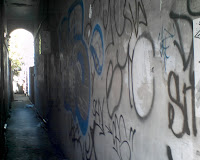
Some example issues raised are graffiti/vandalism, bad use of space, environmental pollution of the town belt, and the possibility the flyover and new tunnel will effect the Basin Reserve area.


Some example issues raised are graffiti/vandalism, bad use of space, environmental pollution of the town belt, and the possibility the flyover and new tunnel will effect the Basin Reserve area.
Subscribe to:
Posts (Atom)